
Bioinspired Molecular Magnetic Field-Responsive Catalyst for On-Demand Switching of 2e− and 4e− Oxygen Reduction

Corresponding Author: Shanlin Qiao
Nano-Micro Letters,
Vol. 19 (2027), Article Number: 26
Abstract
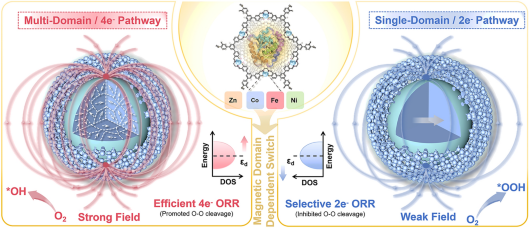
Achieving precise and on-demand steering of the oxygen reduction reaction (ORR) pathway between the efficient 4e− route to H2O and the valuable 2e− route to H2O2 remains a pivotal challenge in electrocatalysis. Herein, we address this challenge by designing a bioinspired molecular magnetic field-responsive catalyst (MMFR-C) via magnetic single-atom-anchored Salen-based covalent organic frameworks (MSA-Salen COFs) onto magnetic nanoparticles (single/multi-domain Fe3O4). Mimicking cytochrome c oxidase, the MMFR-C employs MSA-Salen COFs as an ordered proton-transfer channel and well-defined N2-M-O2 moieties as enzymatic O2 activation sites, with Fe3O4 providing a built-in magnetic field for remote regulation of the active-site electronic structure. The bioinspired MMFR-C exhibits switchable ORR pathways. Relative to the pristine Co-Salen COF (26% H2O2 selectivity, n = 3.48), the MMFR-C integrated with a single-domain Fe3O4 exhibits a remarkably enhanced H2O2 selectivity of 63.9% (n = 2.72), while that with a multi-domain Fe3O4 diverts the ORR pathway toward the 4e− route (n = 3.67). (i) We elucidate that the uniform magnetic field from the single-domain Fe3O4 in MMFR-C favors orbital hybridization between its active N2-M-O2 moieties and the *OOH intermediate, with moderate *OOH adsorption suppressing O–O scission and thus steering ORR selectivity toward H2O2. (ii) In contrast, the enhanced specific magnetism from its multi-domain Fe3O4 core optimizes the d-band center of MMFR-C’s active sites, stabilizes triplet O2 adsorption, and reduces spin-forbidden transition barriers, thereby facilitating O–O cleavage and diverting its ORR pathway to the 4e− route.
Highlights:
1 The bioinspired molecular magnetic field responsive catalysts were synthesized to selectively switch between the 2e− and 4e− oxygen reduction reaction (ORR) pathways.
2 The molecular magnetic field responsive catalyst integrated with single domain Fe3O4 delivers a significantly boosted H2O2 selectivity of 63.9% (electron transfer number, n = 2.72), whereas the multi domain Fe3O4 incorporated variant effectively redirects the ORR exclusively toward the 4e− pathw ay (n = 3.67).
Keywords
Download Citation
Endnote/Zotero/Mendeley (RIS)BibTeX
- K. Chen, J. Huang, J. Chen, J. Gao, Z. Lu et al., Neighboring iron single atomic sites boost PtCo intermetallic activity for high-durability ORR electrocatalysis. Energy Environ. Sci. 18(13), 6732–6743 (2025). https://doi.org/10.1039/d5ee00624d
- Y. Zeng, X. Wang, W. Qi, C. Liu, L. Lu et al., Aligned d-orbital energy level of dual-atom sites catalysts for oxygen reduction reaction in anion exchange membrane fuel cells. Nat. Commun. 16, 8111 (2025). https://doi.org/10.1038/s41467-025-63322-4
- Z. Liang, H. Lei, H. Zheng, H.-Y. Wang, W. Zhang et al., Selective two-electron and four-electron oxygen reduction reactions using co-based electrocatalysts. Chem. Soc. Rev. 54(11), 5248–5291 (2025). https://doi.org/10.1039/d4cs01199f
- Y. He, S. Huang, X. Li, Y. Huang, D. Cao et al., Molecular engineering of covalent organic frameworks for electrocatalytic oxygen reduction reaction. Coord. Chem. Rev. 544, 216972 (2025). https://doi.org/10.1016/j.ccr.2025.216972
- A. Zadehnazari, F. Auras, D. Koumoulis, A. Abbaspourrad, Charge transfer in triphenylamine–tetrazine covalent organic frameworks for solar-driven hydrogen peroxide production. Nat. Commun. 17, 72 (2026). https://doi.org/10.1038/s41467-025-66679-8
- A. Yu, Y. Yang, Atomically dispersed metal catalysts for oxygen reduction reaction: two-electron vs. four-electron pathways. Angew. Chem. Int. Ed. 64(16), e202424161 (2025). https://doi.org/10.1002/anie.202424161
- J. Sun, M. Shen, A. Chang, J. Huang, P. Wang et al., Asymmetric Fe-N3Se single atoms coupled with Fe atomic clusters on alveolar-inspired hierarchically porous carbon submicronspheres for enhanced oxygen reduction. Appl. Catal. B Environ. Energy 383, 126102 (2026). https://doi.org/10.1016/j.apcatb.2025.126102
- C. Yang, F. Sun, Y. Zhang, Z. Qu, J. Zuo et al., Unveiling the coupling effect of sp2 domain size and local active sites in switching the selectivity of nanocarbon catalysts toward the oxygen electro-reduction. Nat. Commun. 16(1), 11270 (2025). https://doi.org/10.1038/s41467-025-66161-5
- Y. Wang, G.I.N. Waterhouse, L. Shang, T. Zhang, Electrocatalytic oxygen reduction to hydrogen peroxide: from homogeneous to heterogeneous electrocatalysis. Adv. Energy Mater. 11(15), 2003323 (2021). https://doi.org/10.1002/aenm.202003323
- Y. Fu, Q. Zhao, Q. Wei, C.R. Bowen, W.-Y. Wong et al., Non-precious metal-based single-atom catalysts for oxygen reduction reaction: fundamentals and applications. Mater. Sci. Eng. R. Rep. 160, 100822 (2024). https://doi.org/10.1016/j.mser.2024.100822
- X. Yan, X. Yuan, L. Ning, L. Bin, Z. Liang et al., Spatial engineering and d-orbital coupling in axial dual-atom sites for bifunctional oxygen catalysis. Nat. Commun. 16, 11376 (2025). https://doi.org/10.1038/s41467-025-66362-y
- M. Yang, W. Song, C. Chen, X. Yang, Z. Zhuang et al., Atomically dispersed Co/Mo sites anchored on mesoporous carbon hollow spheres for highly selective oxygen reduction to hydrogen peroxide in acidic media. Adv. Mater. 37(17), 2416401 (2025). https://doi.org/10.1002/adma.202416401
- Y. Zhao, J. Wan, C. Ling, Y. Wang, H. He et al., Acidic oxygen reduction by single-atom Fe catalysts on curved supports. Nature 644(8077), 668–675 (2025). https://doi.org/10.1038/s41586-025-09364-6
- Y. Shi, L.-L. Zhang, C. Wang, S. Sun, Heterostructure of Fe3O4 confined in hierarchical porous carbon for interface-enhanced medical-grade H2O2 electrosynthesis. Adv. Sci. 12(27), 2502388 (2025). https://doi.org/10.1002/advs.202502388
- X. Dong, S. Tao, G. Wang, J. Chen, R. Wang et al., Microenvironment regulation of asymmetric Fe coordination centers through designing p-n junction toward highly efficient oxygen reduction for rechargeable zinc-air batteries. Nano Energy 134, 110553 (2025). https://doi.org/10.1016/j.nanoen.2024.110553
- P. Shao, Z. Ren, B. Zhao, X. Wang, J. Li et al., Theory-guided design of N-confused porphyrinic covalent organic frameworks for oxygen reduction reaction. J. Am. Chem. Soc. 147(10), 8769–8777 (2025). https://doi.org/10.1021/jacs.4c18645
- X. Mei, X. Zhao, H. Du, B. Deng, H. Zhuo et al., Adjusting the active site of single Co atoms on CeO2 via cyano functional groups for selective H2O2 electrosynthesis at high yield. Appl. Catal. B Environ. Energy 374, 125398 (2025). https://doi.org/10.1016/j.apcatb.2025.125398
- K.-M. Zhao, D.-X. Wu, W.-K. Wu, J.-B. Nie, F.-S. Geng et al., Identifying high-spin hydroxyl-coordinated Fe3+N4 as the active centre for acidic oxygen reduction using molecular model catalysts. Nat. Catal. 8(5), 422–435 (2025). https://doi.org/10.1038/s41929-025-01324-7
- W. Fang, K. Xu, X. Wang, Y. Zhu, X. Li et al., Heteroatom-coordinated Fe-N4 catalysts for enhanced oxygen reduction in alkaline seawater zinc-air batteries. Nano-Micro Lett. 18(1), 96 (2026). https://doi.org/10.1007/s40820-025-01943-6
- P. Vensaus, Y. Liang, J.P. Ansermet, G.J.A.A. Soler-Illia, M. Lingenfelder, Enhancement of electrocatalysis through magnetic field effects on mass transport. Nat. Commun. 15(1), 2867 (2024). https://doi.org/10.1038/s41467-024-46980-8
- Y. Wang, P. Meng, Z. Yang, M. Jiang, J. Yang et al., Regulation of atomic Fe-spin state by crystal field and magnetic field for enhanced oxygen electrocatalysis in rechargeable zinc-air batteries. Angew. Chem. Int. Ed. 62(28), e202304229 (2023). https://doi.org/10.1002/anie.202304229
- J. Song, D. He et al., Magnetic field-enhanced acidic CO2 electroreduction reaction on single nickel-site catalysts. J. Am. Chem. Soc. 147(19), 16198–16206 (2025). https://doi.org/10.1021/jacs.5c00858
- B. Jing, Q. Zhang, M. Liu, S. Yang, J. Zhang et al., Magnetically-altered eg-orbital occupancy to boost the two-electron oxygen reduction electrocatalysis for faster water decontamination. Appl. Catal. B Environ. Energy 369, 125149 (2025). https://doi.org/10.1016/j.apcatb.2025.125149
- Z. Yu, D. Zhang, Y. Wang, F. Liu, F. She et al., Spin manipulation of heterogeneous molecular electrocatalysts by an integrated magnetic field for efficient oxygen redox reactions. Adv. Mater. 36(45), 2470360 (2024). https://doi.org/10.1002/adma.202470360
- M. Wikström, K. Krab, V. Sharma, Oxygen activation and energy conservation by cytochrome c oxidase. Chem. Rev. 118(5), 2469–2490 (2018). https://doi.org/10.1021/acs.chemrev.7b00664
- D. Kass, S. Katz, H. Özgen, S. Mebs, M. Haumann et al., A bioinspired nonheme FeIII–(O22–)–CuII complex with an St = 1 ground state. J. Am. Chem. Soc. 146(36), 24808–24817 (2024). https://doi.org/10.1021/jacs.4c04492
- T. Xie, Y. Wang, Y. Yue, S. Shen, Y. Xiong, Design of covalent organic frameworks mimicking cytochrome c oxidase for enhanced electrocatalytic oxygen reduction. Adv. Funct. Mater. 36(22), e22948 (2026). https://doi.org/10.1002/adfm.202522948
- I. Ishigami, R.G. Sierra, Z. Su, A. Peck, C. Wang et al., Structural insights into functional properties of the oxidized form of cytochrome c oxidase. Nat. Commun. 14(1), 5752 (2023). https://doi.org/10.1038/s41467-023-41533-x
- B. Zhang, L. Chen, Z. Zhang, Q. Li, P. Khangale et al., Modulating the band structure of metal coordinated salen COFs and an in situ constructed charge transfer heterostructure for electrocatalysis hydrogen evolution. Adv. Sci. 9(22), 2105912 (2022). https://doi.org/10.1002/advs.202105912
- W. Zhou, X. Wang, W. Zhao, N. Lu, D. Cong et al., Photocatalytic CO2 reduction to syngas using metallosalen covalent organic frameworks. Nat. Commun. 14, 6971 (2023). https://doi.org/10.1038/s41467-023-42757-7
- M. Liu, J. Zhang, H. Su, Y. Jiang, W. Zhou et al., In situ modulating coordination fields of single-atom cobalt catalyst for enhanced oxygen reduction reaction. Nat. Commun. 15, 1675 (2024). https://doi.org/10.1038/s41467-024-45990-w
- H. Dong, L. Fang, K.-X. Chen, J.-X. Wei, J.-X. Li et al., Dual metallosalen-based covalent organic frameworks for artificial photosynthetic diluted CO2 reduction. Angew. Chem. Int. Ed. 64(2), e202414287 (2025). https://doi.org/10.1002/anie.202414287
- Y. Wada, T. Maruchi, R. Ishii, Y. Sunada, Visible light responsive dinuclear zinc complex consisting of proximally arranged two d10-zinc centers. Angew. Chem. Int. Ed. 62(50), e202310571 (2023). https://doi.org/10.1002/anie.202310571
- X. Ren, T. Wu, Y. Sun, Y. Li, G. Xian et al., Spin-polarized oxygen evolution reaction under magnetic field. Nat. Commun. 12(1), 2608 (2021). https://doi.org/10.1038/s41467-021-22865-y
- J. Ge, R.R. Chen, X. Ren, J. Liu, S.J.H. Ong et al., Ferromagnetic–antiferromagnetic coupling core–shell nanops with spin conservation for water oxidation. Adv. Mater. 33(42), 2101091 (2021). https://doi.org/10.1002/adma.202101091
- L. Wang, J. Bao, L. Wang, F. Zhang, Y. Li, One-pot synthesis and bioapplication of amine-functionalized magnetite nanops and hollow nanospheres. Chem 12(24), 6341–6347 (2006). https://doi.org/10.1002/chem.200501334
- Z.-Y. Mei, G. Zhao, C. Xia, S. Cai, Q. Jing et al., Regulated high-spin state and constrained charge behavior of active cobalt sites in covalent organic frameworks for promoting electrocatalytic oxygen reduction. Angew. Chem. Int. Ed. 62(27), e202303871 (2023). https://doi.org/10.1002/anie.202303871
- H. Zhang, H.-C. Chen, S. Feizpoor, L. Li, X. Zhang et al., Tailoring oxygen reduction reaction kinetics of Fe−N−C catalyst via spin manipulation for efficient zinc–air batteries. Adv. Mater. 36(25), 2400523 (2024). https://doi.org/10.1002/adma.202400523
- C. Wang, Y. Yang, J. Zheng, Y. Yuan, D. Pang et al., Magnetic field-driven spin state transformation in promoting the catalytic activity of doped single-atom for hydrogen evolution reaction. Adv. Mater. 38(6), e13213 (2026). https://doi.org/10.1002/adma.202513213
- Y. Zou, Y. Zhang, C. Zhang, T. Bao, Y. Xi et al., Hydrogen-bonded organic framework@conductive metal-organic framework heterostructures for ampere-level hydrogen peroxide production. Nat. Commun. 16, 10908 (2025). https://doi.org/10.1038/s41467-025-65887-6
- Y. Liu, S. Liu, J. Jiang, X. Wei, K. Zhao et al., Monomolecule coupled to oxygen-doped carbon for efficient electrocatalytic hydrogen peroxide production. Adv. Mater. 37(14), 2502197 (2025). https://doi.org/10.1002/adma.202502197
- Q. Zhi, R. Jiang, X. Yang, Y. Jin, D. Qi et al., Dithiine-linked metalphthalocyanine framework with undulated layers for highly efficient and stable H2O2 electroproduction. Nat. Commun. 15(1), 678 (2024). https://doi.org/10.1038/s41467-024-44899-8
- Z. Bao, J. Zhao, S. Zhang, L. Ding, X. Peng et al., Synergistic effect of doped nitrogen and oxygen-containing functional groups on electrochemical synthesis of hydrogen peroxide. J. Mater. Chem. A 10(9), 4749–4757 (2022). https://doi.org/10.1039/d1ta09915a
- C. Yang, S. Shang, L. Lin, P. Wang, Z. Ye et al., Electro-driven cycling Fenton catalysis through two-dimensional electroresponsive metal–organic frameworks for water purification. Nat. Water 2(8), 793–802 (2024). https://doi.org/10.1038/s44221-024-00262-1
- H. Wu, L. Li, H. Chen, Y. Xing, Z. Wang et al., Topology control of covalent organic frameworks with interlaced unsaturated 2D and saturated 3D units for boosting electrocatalytic hydrogen peroxide production. Angew. Chem. Int. Ed. 63(40), e202410719 (2024). https://doi.org/10.1002/anie.202410719
- T. Xu, H. Zhou, X. Zhang, T.S. Herng, J. Ding et al., Covalent organic frameworks with carbon-centered radical sites for promoting the 4e− oxygen reduction reaction. Angew. Chem. Int. Ed. 64(13), e202424449 (2025). https://doi.org/10.1002/anie.202424449
- C. Xing, Y. Zou, L. Liu, D. Chu, D. Sun et al., Tuning Ni–O orbital interactions to steer oxygen activation for enhanced hydrogen peroxide photosynthesis. Sci. Bull. 71(3), 587–597 (2026). https://doi.org/10.1016/j.scib.2025.12.053
- P. Xia, T. He, T. Xu, Z.-S. Zhu, Y. Sun et al., Unlocking flooded domains in air-breathing cathodes with edge-located asymmetric CoN2O2 sites for robust H2O2 electrosynthesis. Appl. Catal. B Environ. Energy 383, 126099 (2026). https://doi.org/10.1016/j.apcatb.2025.126099
- M. Sun, J. Chen, Z. Zhang, Y. Jing, M. Zhao et al., Ferromagnetic ordering outperforms coordination effects in governing oxygen reduction catalysis on high-index nickel single crystals. Angew. Chem. Int. Ed. 64(31), e202504869 (2025). https://doi.org/10.1002/anie.202504869
- Q. An, X. Qin, X. Li, T. Yao, J. Guo et al., Hydrogen peroxide electrosynthesis under weak thermodynamic driving conditions enabled by in situ spin-state tailoring. Adv. Funct. Mater. 36(31), e27886 (2026). https://doi.org/10.1002/adfm.202527886
- L. Chen, X. Wang, T. Lu, H. Pang, S. Zhang et al., Maneuver of the d-orbital spin polarization of Fe single atomic sites via a near-range axial ligand effect for boosting oxygen reduction reaction. Appl. Catal. B Environ. Energy 366, 125007 (2025). https://doi.org/10.1016/j.apcatb.2024.125007
References
K. Chen, J. Huang, J. Chen, J. Gao, Z. Lu et al., Neighboring iron single atomic sites boost PtCo intermetallic activity for high-durability ORR electrocatalysis. Energy Environ. Sci. 18(13), 6732–6743 (2025). https://doi.org/10.1039/d5ee00624d
Y. Zeng, X. Wang, W. Qi, C. Liu, L. Lu et al., Aligned d-orbital energy level of dual-atom sites catalysts for oxygen reduction reaction in anion exchange membrane fuel cells. Nat. Commun. 16, 8111 (2025). https://doi.org/10.1038/s41467-025-63322-4
Z. Liang, H. Lei, H. Zheng, H.-Y. Wang, W. Zhang et al., Selective two-electron and four-electron oxygen reduction reactions using co-based electrocatalysts. Chem. Soc. Rev. 54(11), 5248–5291 (2025). https://doi.org/10.1039/d4cs01199f
Y. He, S. Huang, X. Li, Y. Huang, D. Cao et al., Molecular engineering of covalent organic frameworks for electrocatalytic oxygen reduction reaction. Coord. Chem. Rev. 544, 216972 (2025). https://doi.org/10.1016/j.ccr.2025.216972
A. Zadehnazari, F. Auras, D. Koumoulis, A. Abbaspourrad, Charge transfer in triphenylamine–tetrazine covalent organic frameworks for solar-driven hydrogen peroxide production. Nat. Commun. 17, 72 (2026). https://doi.org/10.1038/s41467-025-66679-8
A. Yu, Y. Yang, Atomically dispersed metal catalysts for oxygen reduction reaction: two-electron vs. four-electron pathways. Angew. Chem. Int. Ed. 64(16), e202424161 (2025). https://doi.org/10.1002/anie.202424161
J. Sun, M. Shen, A. Chang, J. Huang, P. Wang et al., Asymmetric Fe-N3Se single atoms coupled with Fe atomic clusters on alveolar-inspired hierarchically porous carbon submicronspheres for enhanced oxygen reduction. Appl. Catal. B Environ. Energy 383, 126102 (2026). https://doi.org/10.1016/j.apcatb.2025.126102
C. Yang, F. Sun, Y. Zhang, Z. Qu, J. Zuo et al., Unveiling the coupling effect of sp2 domain size and local active sites in switching the selectivity of nanocarbon catalysts toward the oxygen electro-reduction. Nat. Commun. 16(1), 11270 (2025). https://doi.org/10.1038/s41467-025-66161-5
Y. Wang, G.I.N. Waterhouse, L. Shang, T. Zhang, Electrocatalytic oxygen reduction to hydrogen peroxide: from homogeneous to heterogeneous electrocatalysis. Adv. Energy Mater. 11(15), 2003323 (2021). https://doi.org/10.1002/aenm.202003323
Y. Fu, Q. Zhao, Q. Wei, C.R. Bowen, W.-Y. Wong et al., Non-precious metal-based single-atom catalysts for oxygen reduction reaction: fundamentals and applications. Mater. Sci. Eng. R. Rep. 160, 100822 (2024). https://doi.org/10.1016/j.mser.2024.100822
X. Yan, X. Yuan, L. Ning, L. Bin, Z. Liang et al., Spatial engineering and d-orbital coupling in axial dual-atom sites for bifunctional oxygen catalysis. Nat. Commun. 16, 11376 (2025). https://doi.org/10.1038/s41467-025-66362-y
M. Yang, W. Song, C. Chen, X. Yang, Z. Zhuang et al., Atomically dispersed Co/Mo sites anchored on mesoporous carbon hollow spheres for highly selective oxygen reduction to hydrogen peroxide in acidic media. Adv. Mater. 37(17), 2416401 (2025). https://doi.org/10.1002/adma.202416401
Y. Zhao, J. Wan, C. Ling, Y. Wang, H. He et al., Acidic oxygen reduction by single-atom Fe catalysts on curved supports. Nature 644(8077), 668–675 (2025). https://doi.org/10.1038/s41586-025-09364-6
Y. Shi, L.-L. Zhang, C. Wang, S. Sun, Heterostructure of Fe3O4 confined in hierarchical porous carbon for interface-enhanced medical-grade H2O2 electrosynthesis. Adv. Sci. 12(27), 2502388 (2025). https://doi.org/10.1002/advs.202502388
X. Dong, S. Tao, G. Wang, J. Chen, R. Wang et al., Microenvironment regulation of asymmetric Fe coordination centers through designing p-n junction toward highly efficient oxygen reduction for rechargeable zinc-air batteries. Nano Energy 134, 110553 (2025). https://doi.org/10.1016/j.nanoen.2024.110553
P. Shao, Z. Ren, B. Zhao, X. Wang, J. Li et al., Theory-guided design of N-confused porphyrinic covalent organic frameworks for oxygen reduction reaction. J. Am. Chem. Soc. 147(10), 8769–8777 (2025). https://doi.org/10.1021/jacs.4c18645
X. Mei, X. Zhao, H. Du, B. Deng, H. Zhuo et al., Adjusting the active site of single Co atoms on CeO2 via cyano functional groups for selective H2O2 electrosynthesis at high yield. Appl. Catal. B Environ. Energy 374, 125398 (2025). https://doi.org/10.1016/j.apcatb.2025.125398
K.-M. Zhao, D.-X. Wu, W.-K. Wu, J.-B. Nie, F.-S. Geng et al., Identifying high-spin hydroxyl-coordinated Fe3+N4 as the active centre for acidic oxygen reduction using molecular model catalysts. Nat. Catal. 8(5), 422–435 (2025). https://doi.org/10.1038/s41929-025-01324-7
W. Fang, K. Xu, X. Wang, Y. Zhu, X. Li et al., Heteroatom-coordinated Fe-N4 catalysts for enhanced oxygen reduction in alkaline seawater zinc-air batteries. Nano-Micro Lett. 18(1), 96 (2026). https://doi.org/10.1007/s40820-025-01943-6
P. Vensaus, Y. Liang, J.P. Ansermet, G.J.A.A. Soler-Illia, M. Lingenfelder, Enhancement of electrocatalysis through magnetic field effects on mass transport. Nat. Commun. 15(1), 2867 (2024). https://doi.org/10.1038/s41467-024-46980-8
Y. Wang, P. Meng, Z. Yang, M. Jiang, J. Yang et al., Regulation of atomic Fe-spin state by crystal field and magnetic field for enhanced oxygen electrocatalysis in rechargeable zinc-air batteries. Angew. Chem. Int. Ed. 62(28), e202304229 (2023). https://doi.org/10.1002/anie.202304229
J. Song, D. He et al., Magnetic field-enhanced acidic CO2 electroreduction reaction on single nickel-site catalysts. J. Am. Chem. Soc. 147(19), 16198–16206 (2025). https://doi.org/10.1021/jacs.5c00858
B. Jing, Q. Zhang, M. Liu, S. Yang, J. Zhang et al., Magnetically-altered eg-orbital occupancy to boost the two-electron oxygen reduction electrocatalysis for faster water decontamination. Appl. Catal. B Environ. Energy 369, 125149 (2025). https://doi.org/10.1016/j.apcatb.2025.125149
Z. Yu, D. Zhang, Y. Wang, F. Liu, F. She et al., Spin manipulation of heterogeneous molecular electrocatalysts by an integrated magnetic field for efficient oxygen redox reactions. Adv. Mater. 36(45), 2470360 (2024). https://doi.org/10.1002/adma.202470360
M. Wikström, K. Krab, V. Sharma, Oxygen activation and energy conservation by cytochrome c oxidase. Chem. Rev. 118(5), 2469–2490 (2018). https://doi.org/10.1021/acs.chemrev.7b00664
D. Kass, S. Katz, H. Özgen, S. Mebs, M. Haumann et al., A bioinspired nonheme FeIII–(O22–)–CuII complex with an St = 1 ground state. J. Am. Chem. Soc. 146(36), 24808–24817 (2024). https://doi.org/10.1021/jacs.4c04492
T. Xie, Y. Wang, Y. Yue, S. Shen, Y. Xiong, Design of covalent organic frameworks mimicking cytochrome c oxidase for enhanced electrocatalytic oxygen reduction. Adv. Funct. Mater. 36(22), e22948 (2026). https://doi.org/10.1002/adfm.202522948
I. Ishigami, R.G. Sierra, Z. Su, A. Peck, C. Wang et al., Structural insights into functional properties of the oxidized form of cytochrome c oxidase. Nat. Commun. 14(1), 5752 (2023). https://doi.org/10.1038/s41467-023-41533-x
B. Zhang, L. Chen, Z. Zhang, Q. Li, P. Khangale et al., Modulating the band structure of metal coordinated salen COFs and an in situ constructed charge transfer heterostructure for electrocatalysis hydrogen evolution. Adv. Sci. 9(22), 2105912 (2022). https://doi.org/10.1002/advs.202105912
W. Zhou, X. Wang, W. Zhao, N. Lu, D. Cong et al., Photocatalytic CO2 reduction to syngas using metallosalen covalent organic frameworks. Nat. Commun. 14, 6971 (2023). https://doi.org/10.1038/s41467-023-42757-7
M. Liu, J. Zhang, H. Su, Y. Jiang, W. Zhou et al., In situ modulating coordination fields of single-atom cobalt catalyst for enhanced oxygen reduction reaction. Nat. Commun. 15, 1675 (2024). https://doi.org/10.1038/s41467-024-45990-w
H. Dong, L. Fang, K.-X. Chen, J.-X. Wei, J.-X. Li et al., Dual metallosalen-based covalent organic frameworks for artificial photosynthetic diluted CO2 reduction. Angew. Chem. Int. Ed. 64(2), e202414287 (2025). https://doi.org/10.1002/anie.202414287
Y. Wada, T. Maruchi, R. Ishii, Y. Sunada, Visible light responsive dinuclear zinc complex consisting of proximally arranged two d10-zinc centers. Angew. Chem. Int. Ed. 62(50), e202310571 (2023). https://doi.org/10.1002/anie.202310571
X. Ren, T. Wu, Y. Sun, Y. Li, G. Xian et al., Spin-polarized oxygen evolution reaction under magnetic field. Nat. Commun. 12(1), 2608 (2021). https://doi.org/10.1038/s41467-021-22865-y
J. Ge, R.R. Chen, X. Ren, J. Liu, S.J.H. Ong et al., Ferromagnetic–antiferromagnetic coupling core–shell nanops with spin conservation for water oxidation. Adv. Mater. 33(42), 2101091 (2021). https://doi.org/10.1002/adma.202101091
L. Wang, J. Bao, L. Wang, F. Zhang, Y. Li, One-pot synthesis and bioapplication of amine-functionalized magnetite nanops and hollow nanospheres. Chem 12(24), 6341–6347 (2006). https://doi.org/10.1002/chem.200501334
Z.-Y. Mei, G. Zhao, C. Xia, S. Cai, Q. Jing et al., Regulated high-spin state and constrained charge behavior of active cobalt sites in covalent organic frameworks for promoting electrocatalytic oxygen reduction. Angew. Chem. Int. Ed. 62(27), e202303871 (2023). https://doi.org/10.1002/anie.202303871
H. Zhang, H.-C. Chen, S. Feizpoor, L. Li, X. Zhang et al., Tailoring oxygen reduction reaction kinetics of Fe−N−C catalyst via spin manipulation for efficient zinc–air batteries. Adv. Mater. 36(25), 2400523 (2024). https://doi.org/10.1002/adma.202400523
C. Wang, Y. Yang, J. Zheng, Y. Yuan, D. Pang et al., Magnetic field-driven spin state transformation in promoting the catalytic activity of doped single-atom for hydrogen evolution reaction. Adv. Mater. 38(6), e13213 (2026). https://doi.org/10.1002/adma.202513213
Y. Zou, Y. Zhang, C. Zhang, T. Bao, Y. Xi et al., Hydrogen-bonded organic framework@conductive metal-organic framework heterostructures for ampere-level hydrogen peroxide production. Nat. Commun. 16, 10908 (2025). https://doi.org/10.1038/s41467-025-65887-6
Y. Liu, S. Liu, J. Jiang, X. Wei, K. Zhao et al., Monomolecule coupled to oxygen-doped carbon for efficient electrocatalytic hydrogen peroxide production. Adv. Mater. 37(14), 2502197 (2025). https://doi.org/10.1002/adma.202502197
Q. Zhi, R. Jiang, X. Yang, Y. Jin, D. Qi et al., Dithiine-linked metalphthalocyanine framework with undulated layers for highly efficient and stable H2O2 electroproduction. Nat. Commun. 15(1), 678 (2024). https://doi.org/10.1038/s41467-024-44899-8
Z. Bao, J. Zhao, S. Zhang, L. Ding, X. Peng et al., Synergistic effect of doped nitrogen and oxygen-containing functional groups on electrochemical synthesis of hydrogen peroxide. J. Mater. Chem. A 10(9), 4749–4757 (2022). https://doi.org/10.1039/d1ta09915a
C. Yang, S. Shang, L. Lin, P. Wang, Z. Ye et al., Electro-driven cycling Fenton catalysis through two-dimensional electroresponsive metal–organic frameworks for water purification. Nat. Water 2(8), 793–802 (2024). https://doi.org/10.1038/s44221-024-00262-1
H. Wu, L. Li, H. Chen, Y. Xing, Z. Wang et al., Topology control of covalent organic frameworks with interlaced unsaturated 2D and saturated 3D units for boosting electrocatalytic hydrogen peroxide production. Angew. Chem. Int. Ed. 63(40), e202410719 (2024). https://doi.org/10.1002/anie.202410719
T. Xu, H. Zhou, X. Zhang, T.S. Herng, J. Ding et al., Covalent organic frameworks with carbon-centered radical sites for promoting the 4e− oxygen reduction reaction. Angew. Chem. Int. Ed. 64(13), e202424449 (2025). https://doi.org/10.1002/anie.202424449
C. Xing, Y. Zou, L. Liu, D. Chu, D. Sun et al., Tuning Ni–O orbital interactions to steer oxygen activation for enhanced hydrogen peroxide photosynthesis. Sci. Bull. 71(3), 587–597 (2026). https://doi.org/10.1016/j.scib.2025.12.053
P. Xia, T. He, T. Xu, Z.-S. Zhu, Y. Sun et al., Unlocking flooded domains in air-breathing cathodes with edge-located asymmetric CoN2O2 sites for robust H2O2 electrosynthesis. Appl. Catal. B Environ. Energy 383, 126099 (2026). https://doi.org/10.1016/j.apcatb.2025.126099
M. Sun, J. Chen, Z. Zhang, Y. Jing, M. Zhao et al., Ferromagnetic ordering outperforms coordination effects in governing oxygen reduction catalysis on high-index nickel single crystals. Angew. Chem. Int. Ed. 64(31), e202504869 (2025). https://doi.org/10.1002/anie.202504869
Q. An, X. Qin, X. Li, T. Yao, J. Guo et al., Hydrogen peroxide electrosynthesis under weak thermodynamic driving conditions enabled by in situ spin-state tailoring. Adv. Funct. Mater. 36(31), e27886 (2026). https://doi.org/10.1002/adfm.202527886
L. Chen, X. Wang, T. Lu, H. Pang, S. Zhang et al., Maneuver of the d-orbital spin polarization of Fe single atomic sites via a near-range axial ligand effect for boosting oxygen reduction reaction. Appl. Catal. B Environ. Energy 366, 125007 (2025). https://doi.org/10.1016/j.apcatb.2024.125007