
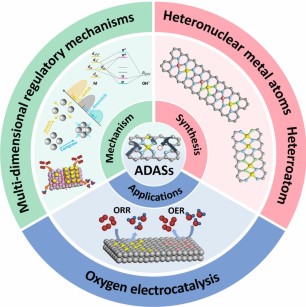
Engineering of Asymmetric Dual-Atom Sites for Effective Oxygen Electrocatalysis

Corresponding Author: Yan Wang
Nano-Micro Letters,
Vol. 18 (2026), Article Number: 316
Abstract
Asymmetric dual-atom site catalysts (ADASCs) inherit the high atomic utilization of single-atom site catalysts and synergistic effects of symmetric dual-atom site catalysts, while uniquely integrating the asymmetry of heteronuclear metal centers and asymmetric coordination environments. This structural merit endows them with tunable electronic configurations and optimized reaction kinetics, breaking conventional catalysts’ inherent limitations to boost catalytic performance significantly. Despite existing reviews on dual-atom site catalysts for electrocatalysis, a comprehensive asymmetry-focused framework to elucidate ADASCs’ catalytic behaviors remains elusive. This review summarizes the multi-dimensional regulation mechanisms of ADASCs. Structurally, heteronuclear metal synergy and bridging ligand co-anchoring suppress single-atom agglomeration. Electronically, d-band center modulation, spin coupling, and orbital hybridization optimize intermediate adsorption energies. Subsequently, the strategies for constructing asymmetric structures are elaborated, including the design of heteronuclear metal centers and the regulation of asymmetric coordination environments via nonmetallic atom engineering. Furthermore, the prominent advantages of ADASCs in oxygen electrocatalysis are highlighted as their asymmetric configurations can break the linear scaling relationship of intermediate adsorption, and optimize the reaction pathway as well as the adsorption behaviors of key intermediates. Finally, the current challenges and opportunities of ADASCs are discussed, providing valuable insights for the development of high-performance energy conversion devices.
Highlights:
1 The multi-dimensional performance optimization mechanisms of asymmetric dual-atom site catalysts (ADASCs) are summarized, laying a fundamental framework for understanding their catalytic behaviors.
2 Various strategies for constructing ADASCs are elaborated, with a focus on heteronuclear metal centers and heteroatom doping engineering to disrupt the symmetry between electric fields and structures.
3 The applications of ADASCs in oxygen electrocatalysis are systematically summarized, and the structure–performance relationship between asymmetric dual-site configurations and catalytic reactions is revealed.
Keywords
Download Citation
Endnote/Zotero/Mendeley (RIS)BibTeX
- Z.-H. Yin, Y. Huang, K. Song, T.-T. Li, J.-Y. Cui et al., Ir single atoms boost metal–oxygen covalency on selenide-derived NiOOH for direct intramolecular oxygen coupling. J. Am. Chem. Soc. 146(10), 6846–6855 (2024). https://doi.org/10.1021/jacs.3c13746
- S. Xu, S. Feng, Y. Yu, D. Xue, M. Liu et al., Dual-site segmentally synergistic catalysis mechanism: boosting CoFeSx nanocluster for sustainable water oxidation. Nat. Commun. 15(1), 1720 (2024). https://doi.org/10.1038/s41467-024-45700-6
- D. Xue, Y. Zhao, J. Cao, Y. Wang, X. Li et al., Spin engineering of dual-atom site catalysts for efficient electrochemical energy conversion. Adv. Mater. 37(35), 2504213 (2025). https://doi.org/10.1002/adma.202504213
- J.A. Turner, Sustainable hydrogen production. Science 305(5686), 972–974 (2004). https://doi.org/10.1126/science.1103197
- S. Chu, A. Majumdar, Opportunities and challenges for a sustainable energy future. Nature 488(7411), 294–303 (2012). https://doi.org/10.1038/nature11475
- L. Li, Y. Wang, R.R. Nazmutdinov, R.R. Zairov, Q. Shao et al., Magnetic field enhanced cobalt iridium alloy catalyst for acidic oxygen evolution reaction. Nano Lett. 24(20), 6148–6157 (2024). https://doi.org/10.1021/acs.nanolett.4c01623
- C. Wang, X. Wu, Y. Chen, B. Zhang, H. Luo et al., Recognition and application of catalysis in secondary rechargeable batteries. ACS Catal. 13(16), 10641–10650 (2023). https://doi.org/10.1021/acscatal.3c02455
- K. Jiao, J. Xuan, Q. Du, Z. Bao, B. Xie et al., Designing the next generation of proton-exchange membrane fuel cells. Nature 595(7867), 361–369 (2021). https://doi.org/10.1038/s41586-021-03482-7
- J. Yu, C. Su, L. Shang, T. Zhang, Single-atom-based oxygen reduction reaction catalysts for proton exchange membrane fuel cells: progress and perspective. ACS Nano 17(20), 19514–19525 (2023). https://doi.org/10.1021/acsnano.3c06522
- H.-Y. Wang, L. Wang, J.-T. Ren, W.-W. Tian, M.-L. Sun et al., Heteroatom-induced accelerated kinetics on nickel selenide for highly efficient hydrazine-assisted water splitting and Zn-hydrazine battery. Nano-Micro Lett. 15(1), 155 (2023). https://doi.org/10.1007/s40820-023-01128-z
- D. Xue, Y. Zhao, H. Xia, J. Cao, Y. Wang, Carbon confinement engineering of ultrafine Pt-based catalyst for robust electrochemical oxygen reduction reaction. Nano Mater. Sci. (2025). https://doi.org/10.1016/j.nanoms.2025.09.006
- J. Jiang, J. Wu, C. Yang, S. Bo, J. Zhang et al., Dynamically dual-center coupled synergistic catalysis for highly efficient oxygen reduction. Angew. Chem. Int. Ed. 64(35), e202510188 (2025). https://doi.org/10.1002/anie.202510188
- J. Suntivich, H.A. Gasteiger, N. Yabuuchi, H. Nakanishi, J.B. Goodenough et al., Design principles for oxygen-reduction activity on perovskite oxide catalysts for fuel cells and metal–air batteries. Nat. Chem. 3(7), 546–550 (2011). https://doi.org/10.1038/nchem.1069
- N. Han, W. Zhang, W. Guo, H. Pan, B. Jiang et al., Designing oxide catalysts for oxygen electrocatalysis: insights from mechanism to application. Nano-Micro Lett. 15(1), 185 (2023). https://doi.org/10.1007/s40820-023-01152-z
- L. Wang, Z.-Y. Yuan, Elevating electrode catalyst stabilization for long-term intermittent alkaline seawater electrolysis. Smart Mater. Devices 11, 202527 (2025). https://doi.org/10.70401/smd.2025.0015
- X. Fan, D. Li, Y. Shu, Y. Feng, F. Li, Confinement effect and application in catalytic oxidation–reduction reaction of confined single-atom catalysts. ACS Catal. 14(17), 12991–13014 (2024). https://doi.org/10.1021/acscatal.4c02113
- Y. Zhou, Q. Zhou, H. Liu, W. Xu, Z. Wang et al., Asymmetric dinitrogen-coordinated nickel single-atomic sites for efficient CO2 electroreduction. Nat. Commun. 14(1), 3776 (2023). https://doi.org/10.1038/s41467-023-39505-2
- Z. Zhang, Z. Zhang, C. Chen, R. Wang, M. Xie et al., Single-atom platinum with asymmetric coordination environment on fully conjugated covalent organic framework for efficient electrocatalysis. Nat. Commun. 15(1), 2556 (2024). https://doi.org/10.1038/s41467-024-46872-x
- S.K. Kaiser, I. Surin, A. Amorós-Pérez, S. Büchele, F. Krumeich et al., Design of carbon supports for metal-catalyzed acetylene hydrochlorination. Nat. Commun. 12, 4016 (2021). https://doi.org/10.1038/s41467-021-24330-2
- Y. Li, Y. Li, H. Sun, L. Gao, X. Jin et al., Current status and perspectives of dual-atom catalysts towards sustainable energy utilization. Nano-Micro Lett. 16(1), 139 (2024). https://doi.org/10.1007/s40820-024-01347-y
- T. Pu, J. Ding, F. Zhang, K. Wang, N. Cao et al., Dual atom catalysts for energy and environmental applications. Angew. Chem. Int. Ed. 62(40), e202305964 (2023). https://doi.org/10.1002/anie.202305964
- Y. Chen, J. Lin, Q. Pan, X. Liu, T. Ma et al., Inter-metal interaction of dual-atom catalysts in heterogeneous catalysis. Angew. Chem. Int. Ed. 62(42), e202306469 (2023). https://doi.org/10.1002/anie.202306469
- T. Li, D. Zhang, Y. Zhang, D. Yang, R. Li et al., A pH-dependent microkinetic modeling guided synthesis of porous dual-atom catalysts for efficient oxygen reduction in Zn–air batteries. Energy Environ. Sci. 18(10), 4949–4961 (2025). https://doi.org/10.1039/d5ee00215j
- R. Li, C. Wang, J. Zhang, W. Guo, Enhanced N2 electroreduction activity of single-atom catalysts: modulating the linear scaling relationship by coordination engineering and dual-site strategies. Nano Res. 18(3), 94907212 (2025). https://doi.org/10.26599/nr.2025.94907212
- P. Cao, X. Mu, F. Chen, S. Wang, Y. Liao et al., Breaking symmetry for better catalysis: insights into single-atom catalyst design. Chem. Soc. Rev. 54(8), 3848–3905 (2025). https://doi.org/10.1039/d4cs01031k
- Y. Sun, W. Fan, Y. Li, N.L.D. Sui, Z. Zhu et al., Tuning coordination structures of Zn sites through symmetry-breaking accelerates electrocatalysis. Adv. Mater. 36(4), e2306687 (2024). https://doi.org/10.1002/adma.202306687
- S. Wei, J. Zhu, X. Chen, R. Yang, K. Gu et al., Planar chlorination engineering induced symmetry-broken single-atom site catalyst for enhanced CO2 electroreduction. Nat. Commun. 16(1), 1652 (2025). https://doi.org/10.1038/s41467-025-56271-5
- J. Xu, S. Lai, D. Qi, M. Hu, X. Peng et al., Atomic Fe–Zn dual-metal sites for high-efficiency pH-universal oxygen reduction catalysis. Nano Res. 14(5), 1374–1381 (2021). https://doi.org/10.1007/s12274-020-3186-x
- L. Zhang, X. Yang, J. Lin, X. Li, X. Liu et al., On the coordination environment of single-atom catalysts: pioneer account. Acc. Chem. Res. 58(12), 1878–1892 (2025). https://doi.org/10.1021/acs.accounts.5c00140
- L. Gloag, S.V. Somerville, J.J. Gooding, R.D. Tilley, Co-catalytic metal–support interactions in single-atom electrocatalysts. Nat. Rev. Mater. 9(3), 173–189 (2024). https://doi.org/10.1038/s41578-023-00633-2
- Z. Zhang, C. Jia, P. Ma, C. Feng, J. Yang et al., Distance effect of single atoms on stability of cobalt oxide catalysts for acidic oxygen evolution. Nat. Commun. 15(1), 1767 (2024). https://doi.org/10.1038/s41467-024-46176-0
- Z. Lei, W. Cai, Y. Rao, K. Wang, Y. Jiang et al., Coordination modulation of iridium single-atom catalyst maximizing water oxidation activity. Nat. Commun. 13(1), 24 (2022). https://doi.org/10.1038/s41467-021-27664-z
- K. Jiang, M. Luo, M. Peng, Y. Yu, Y.-R. Lu et al., Dynamic active-site generation of atomic iridium stabilized on nanoporous metal phosphides for water oxidation. Nat. Commun. 11(1), 2701 (2020). https://doi.org/10.1038/s41467-020-16558-1
- A. Kumar, N. Goyal, S. Mathur, I.A. Bakhtiyarovich, Y. Zhao et al., Advances in coordination engineering of M–N–C single atom catalysts for superior oxygen reduction performance. Coord. Chem. Rev. 549, 217244 (2026). https://doi.org/10.1016/j.ccr.2025.217244
- X. Duan, Q. Sha, P. Li, T. Li, G. Yang et al., Dynamic chloride ion adsorption on single iridium atom boosts seawater oxidation catalysis. Nat. Commun. 15(1), 1973 (2024). https://doi.org/10.1038/s41467-024-46140-y
- X. Wei, M. An, X. Tang, J. Wei, P. Yan et al., Near-100% site utilization of single atoms for efficient electrocatalysis. Nat. Commun. 17(1), 1013 (2026). https://doi.org/10.1038/s41467-025-67756-8
- H. Liu, P. Li, K. Fan, F. Lu, Q. Sun et al., Microporous hard carbon support provokes exceptional performance of single atom electrocatalysts for advanced air cathodes. Angew. Chem. Int. Ed. 64(23), e202501307 (2025). https://doi.org/10.1002/anie.202501307
- C. Xia, Y. Qiu, Y. Xia, P. Zhu, G. King et al., General synthesis of single-atom catalysts with high metal loading using graphene quantum dots. Nat. Chem. 13(9), 887–894 (2021). https://doi.org/10.1038/s41557-021-00734-x
- E. Luo, Y. Chu, J. Liu, Z. Shi, S. Zhu et al., Pyrolyzed M-Nx catalysts for oxygen reduction reaction: progress and prospects. Energy Environ. Sci. 14(4), 2158–2185 (2021). https://doi.org/10.1039/d1ee00142f
- Y. Zhao, J. Wan, C. Ling, Y. Wang, H. He et al., Acidic oxygen reduction by single-atom Fe catalysts on curved supports. Nature 644(8077), 668–675 (2025). https://doi.org/10.1038/s41586-025-09364-6
- R. Jasinski, A new fuel cell cathode catalyst. Nature 201(4925), 1212–1213 (1964). https://doi.org/10.1038/2011212a0
- B. Qiao, A. Wang, X. Yang, L.F. Allard, Z. Jiang et al., Single-atom catalysis of CO oxidation using Pt1/FeOx. Nat. Chem. 3(8), 634–641 (2011). https://doi.org/10.1038/nchem.1095
- P. Yin, T. Yao, Y. Wu, L. Zheng, Y. Lin et al., Single cobalt atoms with precise N-coordination as superior oxygen reduction reaction catalysts. Angew. Chem. Int. Ed. 55(36), 10800–10805 (2016). https://doi.org/10.1002/anie.201604802
- Y. Han, Y. Wang, R. Xu, W. Chen, L. Zheng et al., Electronic structure engineering to boost oxygen reduction activity by controlling the coordination of the central metal. Energy Environ. Sci. 11(9), 2348–2352 (2018). https://doi.org/10.1039/c8ee01481g
- N. Zhang, T. Zhou, J. Ge, Y. Lin, Z. Du et al., High-density planar-like Fe2N6 structure catalyzes efficient oxygen reduction. Matter 3(2), 509–521 (2020). https://doi.org/10.1016/j.matt.2020.06.026
- L. Zhang, N. Zhang, H. Shang, Z. Sun, Z. Wei et al., High-density asymmetric iron dual-atom sites for efficient and stable electrochemical water oxidation. Nat. Commun. 15, 9440 (2024). https://doi.org/10.1038/s41467-024-53871-5
- Y. Zhao, Z. Gao, S. Zhang, X. Guan, W. Xu et al., Asymmetric-charge-distributed Co–Mn diatomic catalyst enables efficient oxygen reduction reaction. Adv. Funct. Mater. 35(37), 2504260 (2025). https://doi.org/10.1002/adfm.202504260
- G. Yang, J. Zhu, P. Yuan, Y. Hu, G. Qu et al., Regulating Fe-spin state by atomically dispersed Mn–N in Fe–N–C catalysts with high oxygen reduction activity. Nat. Commun. 12(1), 1734 (2021). https://doi.org/10.1038/s41467-021-21919-5
- D. Xue, H. Xia, W. Yan, J. Zhang, S. Mu, Defect engineering on carbon-based catalysts for electrocatalytic CO2 reduction. Nano-Micro Lett. 13(1), 5 (2020). https://doi.org/10.1007/s40820-020-00538-7
- K. Huang, R. Li, H. Qi, S. Yang, S. An et al., Regulating adsorption of intermediates via the sulfur modulating dual-atomic sites for boosting CO2RR. ACS Catal. 14(11), 8889–8898 (2024). https://doi.org/10.1021/acscatal.4c02098
- H. Lv, Y. Gao, D.-S. Li, A. Yu, C. Sun et al., Mediation of oxidation and spin states of Fe/P-CoO2 core–shell structures catalysts for oxygen evolution reaction. Adv. Funct. Mater. 35(16), 2418334 (2025). https://doi.org/10.1002/adfm.202418334
- Y. Hu, Z. Li, B. Li, C. Yu, Recent progress of diatomic catalysts: general design fundamentals and diversified catalytic applications. Small 18(46), e2203589 (2022). https://doi.org/10.1002/smll.202203589
- S. Biswas, J. Zhou, X.-L. Chen, Q.-Y. Zhang, Y.-R. Li et al., Asymmetric electronic distribution at Mn–Cu dual atomic sites promoting electrochemical conversion of N2 to NH3. Angew. Chem. Int. Ed. 64(44), e202507947 (2025). https://doi.org/10.1002/anie.202507947
- L. Ran, Y. Zhang, W. Tong, L. Chen, M. Wang et al., Circumventing radical generation on Fe–V atomic pair catalyst for robust oxygen reduction and zinc-air batteries. Angew. Chem. Int. Ed. 64(45), e202514542 (2025). https://doi.org/10.1002/anie.202514542
- C. Zhang, Y. Guo, C. Chen, Z. Zhuang, S. You et al., Accelerated O–O bond cleavage and stabilized Fe sites by synergistic d–p Fe–Sn dual-atom pair for enhanced oxygen reduction. Angew. Chem. Int. Ed. 65(7), e24265 (2026). https://doi.org/10.1002/anie.202524265
- B. Tang, Y. Zhou, Q. Ji, Z. Zhuang, L. Zhang et al., A Janus dual-atom catalyst for electrocatalytic oxygen reduction and evolution. Nat. Synth 3(7), 878–890 (2024). https://doi.org/10.1038/s44160-024-00545-1
- L. Li, J. Zhu, F. Kong, Y. Wang, C. Kang et al., Tailoring atomic strain environment for high-performance acidic oxygen reduction by Fe-Ru dual atoms communicative effect. Matter 7(4), 1517–1532 (2024). https://doi.org/10.1016/j.matt.2024.01.019
- L.-J. Yuan, Z.-Y. Miao, X.-L. Sui, C.-F. Lee, Q. Li et al., Janus effect of FeCo dual atom catalyst with Co as active center in acidic oxygen reduction reaction. Nat. Commun. 16(1), 7198 (2025). https://doi.org/10.1038/s41467-025-62728-4
- Z. Zhang, Z. Xing, X. Luo, C. Cheng, X. Liu, Densely populated macrocyclic dicobalt sites in ladder polymers for low-overpotential oxygen reduction catalysis. Nat. Commun. 16(1), 921 (2025). https://doi.org/10.1038/s41467-025-56066-8
- J.-M. Heng, H.-L. Zhu, Z.-H. Zhao, P.-Q. Liao, X.-M. Chen, Fabrication of ultrahigh-loading dual copper sites in nitrogen-doped porous carbons boosting electroreduction of CO2 to C2H4 under neutral conditions. Adv. Mater. 37(4), e2415101 (2025). https://doi.org/10.1002/adma.202415101
- T. Liu, Y. Zhao, T. Zhai, Does a higher density of active sites indicate a higher reaction rate? J. Am. Chem. Soc. 146(10), 6461–6465 (2024). https://doi.org/10.1021/jacs.3c14625
- J. Xiang, P. Wang, P. Li, M. Zhou, G. Yu et al., Inter-site distance effect in electrocatalysis. Angew. Chem. Int. Ed. 64(21), e202500644 (2025). https://doi.org/10.1002/anie.202500644
- X. Tang, Y. Wei, W. Zhai, Y. Wu, T. Hu et al., Carbon nanocage with maximum utilization of atomically dispersed iron as efficient oxygen electroreduction nanoreactor. Adv. Mater. 35(5), e2208942 (2023). https://doi.org/10.1002/adma.202208942
- R. Sui, B. Liu, C. Chen, X. Tan, C. He et al., Constructing asymmetric Fe–Nb diatomic sites to enhance ORR activity and durability. J. Am. Chem. Soc. 146(38), 26442–26453 (2024). https://doi.org/10.1021/jacs.4c09642
- X. Wang, L. Xu, C. Li, C. Zhang, H. Yao et al., Developing a class of dual atom materials for multifunctional catalytic reactions. Nat. Commun. 14(1), 7210 (2023). https://doi.org/10.1038/s41467-023-42756-8
- C. Liu, Y. Zhai, Z. Li, H. Sun, Y. Liu, Atomically dispersed Mn-Ir sites on 2D amorphous carbon materials synergistically boost electrochemical overall water splitting. Small 21(14), e2411238 (2025). https://doi.org/10.1002/smll.202411238
- M. Qi, M.J. Zachman, Y. Li, Y. Zeng, S. Hwang et al., Highly dense atomic Fe–Ni dual metal sites for efficient CO2 to CO electrolyzers at industrial current densities. Energy Environ. Sci. 18(11), 5643–5656 (2025). https://doi.org/10.1039/d5ee01081k
- Z. Li, B. Li, Y. Hu, X. Liao, H. Yu et al., Emerging ultrahigh-density single-atom catalysts for versatile heterogeneous catalysis applications: redefinition, recent progress, and challenges. Small Struct. 3(6), 2200041 (2022). https://doi.org/10.1002/sstr.202200041
- D. Chen, Y. Cai, Y. Xiao, C. Wang, Y. Li et al., Electrosynthesis of urea on high-density Ga─Y dual-atom catalyst via cross-tuning. Adv. Mater. 37(14), e2420593 (2025). https://doi.org/10.1002/adma.202420593
- Y. He, H. Li, Y. Wang, Y. Jia, Y. Liu et al., Heteroatom anchors Fe–Mn dual-atom catalysts with bi-functional oxygen catalytic activity for low-temperature rechargeable flexible Zn-air batteries. J. Energy Chem. 90, 610–620 (2024). https://doi.org/10.1016/j.jechem.2023.10.061
- H. Jin, R. Zhao, P. Cui, X. Liu, J. Yan et al., Sabatier phenomenon in hydrogenation reactions induced by single-atom density. J. Am. Chem. Soc. 145(22), 12023–12032 (2023). https://doi.org/10.1021/jacs.3c00786
- Z. Jin, P. Li, Y. Meng, Z. Fang, D. Xiao et al., Understanding the inter-site distance effect in single-atom catalysts for oxygen electroreduction. Nat. Catal. 4(7), 615–622 (2021). https://doi.org/10.1038/s41929-021-00650-w
- T. Huang, J. Xiao, X. Liu, X. Liu, J. He et al., Engineering Ru and Ni sites relay catalysis and strong metal-support interaction for synergetic enhanced electrocatalytic hydrogen evolution performance. Chem. Eng. J. 509, 161348 (2025). https://doi.org/10.1016/j.cej.2025.161348
- J. Wei, H. Tang, L. Sheng, R. Wang, M. Fan et al., Site-specific metal-support interaction to switch the activity of Ir single atoms for oxygen evolution reaction. Nat. Commun. 15, 559 (2024). https://doi.org/10.1038/s41467-024-44815-0
- J. Lv, Q. Yang, T. Liang, X. Sun, W. Rong et al., Accelerating nitrate electroreduction to ammonia via metal-support interactions in Ni-WS2 catalysts. J. Am. Chem. Soc. 147(31), 27708–27719 (2025). https://doi.org/10.1021/jacs.5c06333
- N. He, Y. Sun, X. Chen, J. Wang, G. Liang et al., Design of S, N-codoped Co–Fe dual-atom sites for efficient alkaline oxygen reduction. J. Mater. Chem. A 12(17), 10101–10109 (2024). https://doi.org/10.1039/d3ta06626f
- M. Liu, Y. Li, L. Yang, P. Zhao, J. Li et al., Defect-triggered orbital hybridization in FeMn dual-atom catalysts toward Sabatier-optimized oxygen reduction. Angew. Chem. Int. Ed. 64(28), e202505268 (2025). https://doi.org/10.1002/anie.202505268
- X. Ao, L. Li, Y. Ding, G. Nam, B. Zhao et al., Interatomic Fe–Cu cooperation in nitrogen-doped carbon for enhanced oxygen reduction. Energy Environ. Sci. 18(15), 7624–7634 (2025). https://doi.org/10.1039/d5ee01457c
- L. Chen, S. Yang, S. Yao, Z. Si, G. Ding et al., Modulating adsorption configuration of intermediates on Cu-In dual-atom catalyst for boosted urea electrosynthesis. Appl. Catal. B Environ. Energy 379, 125710 (2025). https://doi.org/10.1016/j.apcatb.2025.125710
- D. Li, W. Ma, M.K. Eswaran, C. Li, J. Chen et al., Strengthened Ru–O bonds for robust oxygen evolution in acid media. ACS Catal. 15(15), 13069–13084 (2025). https://doi.org/10.1021/acscatal.5c02453
- S. Zhu, R. Yang, Y. Xu, X. Li, Z. Shi et al., Mixed ionic-covalent bonds achieve durable acidic water oxidation. J. Am. Chem. Soc. 147(43), 39494–39504 (2025). https://doi.org/10.1021/jacs.5c12381
- X. Sun, R.B. Araujo, E.C. dos Santos, Y. Sang, H. Liu et al., Advancing electrocatalytic reactions through mapping key intermediates to active sites via descriptors. Chem. Soc. Rev. 53(14), 7392–7425 (2024). https://doi.org/10.1039/d3cs01130e
- P. Zeng, X. Li, B. Zhao, J. Gao, W. Feng et al., Electronic structure engineering in electrocatalysts: enabling regulated redox mediation for advanced lithium-sulfur chemistry. Adv. Energy Mater. 15(32), 2501603 (2025). https://doi.org/10.1002/aenm.202501603
- M. Che, Nobel Prize in chemistry 1912 to Sabatier: organic chemistry or catalysis? Catal. Today 218, 162–171 (2013). https://doi.org/10.1016/j.cattod.2013.07.006
- X. Wang, S. Li, Z. Yuan, Y. Sun, Z. Tang et al., Optimizing electrocatalytic nitrogen reduction via interfacial electric field modulation: elevating d-band center in WS2-WO3 for enhanced intermediate adsorption. Angew. Chem. Int. Ed. 62(29), e202303794 (2023). https://doi.org/10.1002/anie.202303794
- P. Kuang, Z. Ni, B. Zhu, Y. Lin, J. Yu, Modulating the d-band center enables ultrafine Pt3Fe alloy nanops for pH-universal hydrogen evolution reaction. Adv. Mater. 35(41), e2303030 (2023). https://doi.org/10.1002/adma.202303030
- H. Guo, S. Guo, Strain engineering of multimetallic nanomaterials for advanced electrocatalysis. CCS Chem. 7(2), 326–344 (2025). https://doi.org/10.31635/ccschem.024.202404677
- Q. Zhang, D. Liu, Y. Zhang, Z. Guo, M. Chen et al., Insight into coupled Ni-Co dual-metal atom catalysts for efficient synergistic electrochemical CO2 reduction. J. Energy Chem. 87, 509–517 (2023). https://doi.org/10.1016/j.jechem.2023.08.046
- B. Cao, M. Hu, Y. Cheng, P. Jing, B. Liu et al., Tailoring the d-band center of N-doped carbon nanotube arrays with CoN4 nanops and single-atom Co for a superior hydrogen evolution reaction. NPG Asia Mater. 13, 1 (2021). https://doi.org/10.1038/s41427-020-00264-x
- Y. Zhang, Y. Wang, N. Ma, B. Liang, Y. Xiong et al., Revealing the adsorption behavior of nitrogen reduction reaction on strained Ti2CO2 by a spin-polarized d-band center model. Small 20(9), e2306840 (2024). https://doi.org/10.1002/smll.202306840
- Y. Zhang, F. Li, S. Li, Z. Zhang, Z. Sun et al., Asymmetric dual-atomic catalyst with axial chloride coordination for efficient oxygen reduction reaction. Adv. Mater. 37(33), e2507478 (2025). https://doi.org/10.1002/adma.202507478
- K. Song, Y. Feng, X. Zhou, T. Qin, X. Zou et al., Exploiting the trade-offs of electron transfer in MOF-derived single Zn/Co atomic couples for performance-enhanced zinc-air battery. Appl. Catal. B Environ. 316, 121591 (2022). https://doi.org/10.1016/j.apcatb.2022.121591
- X. Xu, J. Guan, Spin effect in dual-atom catalysts for electrocatalysis. Chem. Sci. 15(36), 14585–14607 (2024). https://doi.org/10.1039/d4sc04370g
- X.-W. Lv, J. Gong, S. Wang, X. Yan, C. Sun et al., Engineering orbital hybridization in advanced electrocatalysts for energy conversion: fundamentals, modulations, and perspectives. Adv. Energy Mater. 15(30), 2501129 (2025). https://doi.org/10.1002/aenm.202501129
- J. Jiang, S. Liu, B. Zhao, T. Sun, Y. Zhang et al., Angstrom confinement-triggered adaptive spin state transition of CoMn dual single atoms for efficient singlet oxygen generation. Adv. Mater. 37(10), e2417834 (2025). https://doi.org/10.1002/adma.202417834
- A. Kulkarni, S. Siahrostami, A. Patel, J.K. Nørskov, Understanding catalytic activity trends in the oxygen reduction reaction. Chem. Rev. 118(5), 2302–2312 (2018). https://doi.org/10.1021/acs.chemrev.7b00488
- Z. Zhang, Y. Dai, P. Guo, B. Liu, Y. Xia et al., Noncovalent assembly strategy for efficient synthesis of dual-atom catalysts. Adv. Funct. Mater. 34(44), 2407128 (2024). https://doi.org/10.1002/adfm.202407128
- Y. Liu, X. Ren, J. Wang, H. Wang, Z. Yin et al., Spin-state effect of tetrahedron-coordinated single-atom catalysts on CO2 electroreduction. J. Am. Chem. Soc. 147(24), 20318–20328 (2025). https://doi.org/10.1021/jacs.4c18550
- Z. Jin, M. Yang, Y. Dong, X. Ma, Y. Wang et al., Atomic dispersed hetero-pairs for enhanced electrocatalytic CO2 reduction. Nano-Micro Lett. 16(1), 4 (2023). https://doi.org/10.1007/s40820-023-01214-2
- W. Zhang, Y. Chao, W. Zhang, J. Zhou, F. Lv et al., Emerging dual-atomic-site catalysts for efficient energy catalysis. Adv. Mater. 33(36), e2102576 (2021). https://doi.org/10.1002/adma.202102576
- J. Gracia, Itinerant spins and bond lengths in oxide electrocatalysts for oxygen evolution and reduction reactions. J. Phys. Chem. C 123(15), 9967–9972 (2019). https://doi.org/10.1021/acs.jpcc.9b01635
- J. Gracia, R. Sharpe, J. Munarriz, Principles determining the activity of magnetic oxides for electron transfer reactions. J. Catal. 361, 331–338 (2018). https://doi.org/10.1016/j.jcat.2018.03.012
- W. Cao, X.-H. Gao, J. Wu, A.-Q. Huang, H. Hu et al., Regulating the spin polarization of NiFe layered double hydroxide for the enhanced oxygen evolution reaction. ACS Catal. 14(5), 3640–3646 (2024). https://doi.org/10.1021/acscatal.3c06180
- H. Li, J. Wang, R. Qi, Y. Hu, J. Zhang et al., Enhanced Fe 3d delocalization and moderate spin polarization in Fe Ni atomic pairs for bifunctional ORR and OER electrocatalysis. Appl. Catal. B Environ. 285, 119778 (2021). https://doi.org/10.1016/j.apcatb.2020.119778
- H. Jia, N. Yao, Z. Liao, L. Wu, J. Zhu et al., Understanding the role of spin state in cobalt oxyhydroxides for water oxidation. Angew. Chem. Int. Ed. 63(47), e202408005 (2024). https://doi.org/10.1002/anie.202408005
- X. Li, W. Xu, Y. Fang, R. Hu, J. Yu et al., Single-atom catalyst application in distributed renewable energy conversion and storage. SusMat 3(2), 160–179 (2023). https://doi.org/10.1002/sus2.114
- Z. Jiang, J. Wang, D. Zhang, P. Kong, X. Zhang, D-electron asymmetry-driven CN coupling on heteronuclear dual-atom catalysts for sustainable urea electrosynthesis. Adv. Sci. 12(40), e11001 (2025). https://doi.org/10.1002/advs.202511001
- N. Xu, Y. Jin, Q. Liu, M. Yu, X. Wang et al., Rational design of diatomic active sites for elucidating oxygen evolution reaction performance trends. Angew. Chem. Int. Ed. 64(1), e202413749 (2025). https://doi.org/10.1002/anie.202413749
- K. Cheng, D. Shen, Y. Xia, K. Dai, C. Shao et al., Operando XAFS deciphering dynamic evolution of heteronuclear Cu–Ni from atomic sites to atomic clusters for enhanced CO2 electroreduction. Angew. Chem. Int. Ed. 64(34), e202508932 (2025). https://doi.org/10.1002/anie.202508932
- L. Qi, J. Guan, Orbital hybridizations in single-atom catalysts for electrocatalysis. Sci. Bull. 70(11), 1856–1871 (2025). https://doi.org/10.1016/j.scib.2025.04.009
- J. Qiao, Y. You, L. Kong, W. Feng, H. Zhang et al., Precisely constructing orbital-coupled Fe─Co dual-atom sites for high-energy-efficiency Zn-air/iodide hybrid batteries. Adv. Mater. 36(32), e2405533 (2024). https://doi.org/10.1002/adma.202405533
- X. Ma, Y. Zhou, S. Zhang, W. Lei, Y. Zhao et al., 3d–5d orbital hybridization in nanoflower-like high-entropy alloy for highly efficient overall water splitting at high current density. Small 21(7), e2411394 (2025). https://doi.org/10.1002/smll.202411394
- B. Peng, H. She, Z. Wei, Z. Sun, Z. Deng et al., Sulfur-doping tunes p–d orbital coupling over asymmetric Zn–Sn dual-atom for boosting CO2 electroreduction to formate. Nat. Commun. 16(1), 2217 (2025). https://doi.org/10.1038/s41467-025-57573-4
- X. Wang, N. Zhang, S. Guo, H. Shang, X. Luo et al., P-d orbital hybridization induced by asymmetrical FeSn dual atom sites promotes the oxygen reduction reaction. J. Am. Chem. Soc. 146(31), 21357–21366 (2024). https://doi.org/10.1021/jacs.4c03576
- S. Sun, Y. Zhang, X. Shi, W. Sun, C. Felser et al., From charge to spin: an in-depth exploration of electron transfer in energy electrocatalysis. Adv. Mater. 36(37), e2312524 (2024). https://doi.org/10.1002/adma.202312524
- Y. Li, H. Wang, C. Chen, X. Xie, Y. Yang et al., Ten thousand hour stable zinc air batteries via Fe and W dual atom sites. Nat. Commun. 16(1), 8085 (2025). https://doi.org/10.1038/s41467-025-63540-w
- R. Cheng, Y. Min, H. Li, C. Fu, Electronic structure regulation in the design of low-cost efficient electrocatalysts: from theory to applications. Nano Energy 115, 108718 (2023). https://doi.org/10.1016/j.nanoen.2023.108718
- P. Zhu, X. Xiong, X. Wang, C. Ye, J. Li et al., Regulating the FeN4 moiety by constructing Fe-Mo dual-metal atom sites for efficient electrochemical oxygen reduction. Nano Lett. 22(23), 9507–9515 (2022). https://doi.org/10.1021/acs.nanolett.2c03623
- L. Yang, H. Cheng, H. Li, G. Sun, S. Liu et al., Atomic confinement empowered CoZn dual-single-atom nanotubes for H2O2 production in sequential dual-cathode electro-Fenton process. Adv. Mater. 36(44), e2406957 (2024). https://doi.org/10.1002/adma.202406957
- Y. Hu, Y. Fan, L. Li, J. Zhou, Z. Hu et al., Modulating 3d charge state via halogen ions in neighboring molecules of metal-organic frameworks for improving water oxidation. Small 20(34), e2400042 (2024). https://doi.org/10.1002/smll.202400042
- E. Sebastian, M. Hariharan, Symmetry-breaking charge separation in molecular constructs for efficient light energy conversion. ACS Energy Lett. 7(2), 696–711 (2022). https://doi.org/10.1021/acsenergylett.1c02412
- J.-T. Ren, L. Chen, H.-Y. Wang, Y. Feng, Z.-Y. Yuan, Hydrogen oxidation electrocatalysts for anion-exchange membrane fuel cells: activity descriptors, stability regulation, and perspectives. Energy Environ. Sci. 17(12), 3960–4009 (2024). https://doi.org/10.1039/d3ee04251k
- X. Hu, S. Cheng, U. Farooq, I. Ul-Islam, X. Wang, Theory-guided design of surface-enhanced Ni-Mn diatomic site catalysts for efficient seawater electrolysis via the degradation of high ionization potential organic pollutants. Angew. Chem. Int. Ed. 64(24), e2025094 (2025). https://doi.org/10.1002/anie.202505094
- Z. Zhang, S. Lu, M. Zhu, F. Wang, K. Yang et al., Enhancing water oxidation performance of transition metal oxides by atomically precise heteroatom doping. J. Am. Chem. Soc. 147(26), 22806–22817 (2025). https://doi.org/10.1021/jacs.5c04572
- W. Zheng, Y. Zhao, K. Jiang, F. Xie, L. Meng et al., Heteroatom dopants overcome the activity-stability trade-off in RuO2 for acidic oxygen evolution. Nat. Commun. 16(1), 6716 (2025). https://doi.org/10.1038/s41467-025-62036-x
- Y. Liu, S. Yuan, C. Sun, C. Wang, X. Liu et al., Optimizing Fe-3d electron delocalization by asymmetric Fe–Cu diatomic configurations for efficient anion exchange membrane fuel cells. Adv. Energy Mater. 13(46), 2302719 (2023). https://doi.org/10.1002/aenm.202302719
- S. Huang, F. Lin, S. Wang, X. Zeng, H. Ling et al., Asymmetric microenvironment tailoring strategies of atomically dispersed dual-site catalysts for oxygen reduction and CO2 reduction reactions. Adv. Mater. 36(41), 2407974 (2024). https://doi.org/10.1002/adma.202407974
- Q. An, X. Zhang, C. Yang, H. Su, W. Zhou et al., Engineering unsymmetrically coordinated Fe sites via heteroatom pairs synergetic contribution for efficient oxygen reduction. Small 19(49), 2304303 (2023). https://doi.org/10.1002/smll.202304303
- Y. Li, X. Luo, Z. Wei, F. Zhang, Z. Sun et al., Precisely constructing charge-asymmetric dual-atom Fe sites supported on hollow porous carbon spheres for efficient oxygen reduction. Energy Environ. Sci. 17(13), 4646–4657 (2024). https://doi.org/10.1039/d4ee01309c
- G.P. Kharabe, S. Barik, S.K. Veeranmaril, A. Nair, R. Illathvalappil et al., Aluminium, nitrogen-dual-doped reduced graphene oxide co-existing with cobalt-encapsulated graphitic carbon nanotube as an activity modulated electrocatalyst for oxygen electrocatalyst for oxygen electrochemistry applications. Small 20(35), e2400012 (2024). https://doi.org/10.1002/smll.202400012
- C. Chen, Z. Sun, G. Qin, B. Wang, M. Liu et al., Asymmetrically coordinated Cu dual-atom-sites enables selective CO2 electroreduction to ethanol. Adv. Mater. 36(48), e2409797 (2024). https://doi.org/10.1002/adma.202409797
- D. Dang, L. Zhang, G. Long, C. Liu, W. Fan et al., Modulation the coordination of Fe–Co diatomic sites with boron atom for fuel cells and Zn–Air battery. Appl. Catal. B Environ. Energy 379, 125679 (2025). https://doi.org/10.1016/j.apcatb.2025.125679
- G. Liu, W. Wang, P. Zeng, C. Yuan, L. Wang et al., Strengthened d–p orbital hybridization through asymmetric coordination engineering of single-atom catalysts for durable lithium–sulfur batteries. Nano Lett. 22(15), 6366–6374 (2022). https://doi.org/10.1021/acs.nanolett.2c02183
- R. Li, Z. Zhang, X. Liang, J. Shen, J. Wang et al., Polystyrene waste thermochemical hydrogenation to ethylbenzene by a N-bridged co, Ni dual-atom catalyst. J. Am. Chem. Soc. 145(29), 16218–16227 (2023). https://doi.org/10.1021/jacs.3c05184
- Y. Chai, S. Chen, Y. Chen, F. Wei, L. Cao et al., Dual-atom catalyst with N-colligated Zn1Co1 species as dominant active sites for propane dehydrogenation. J. Am. Chem. Soc. 146(1), 263–273 (2024). https://doi.org/10.1021/jacs.3c08616
- L. Wang, X.-W. Lv, H.-Y. Wang, J.-T. Ren, Y. Feng et al., Rational d-orbitals modulation for tailoring Co2P interfacial adsorption behavior: boosting alkaline hydrogen evolution. Adv. Energy Mater. 15(43), e04036 (2025). https://doi.org/10.1002/aenm.202504036
- Z. Yao, H. Cheng, Y. Xu, X. Zhan, S. Hong et al., Hydrogen radical-boosted electrocatalytic CO2 reduction using Ni-partnered heteroatomic pairs. Nat. Commun. 15(1), 9881 (2024). https://doi.org/10.1038/s41467-024-53529-2
- Y. Wang, J. Wu, S. Tang, J. Yang, C. Ye et al., Synergistic Fe−Se atom pairs as bifunctional oxygen electrocatalysts boost low-temperature rechargeable Zn-air battery. Angew. Chem. Int. Ed. 62(15), e202219191 (2023). https://doi.org/10.1002/anie.202219191
- Y. Yang, Y. Qian, H. Li, Z. Zhang, Y. Mu et al., O-coordinated W-Mo dual-atom catalyst for pH-universal electrocatalytic hydrogen evolution. Sci. Adv. (2020). https://doi.org/10.1126/sciadv.aba6586
- X. Sun, Y. Qiu, B. Jiang, Z. Chen, C. Zhao et al., Isolated Fe-Co heteronuclear diatomic sites as efficient bifunctional catalysts for high-performance lithium-sulfur batteries. Nat. Commun. 14(1), 291 (2023). https://doi.org/10.1038/s41467-022-35736-x
- Y. Wang, X. Sun, H. Wang, Y. Wu, P. Duan et al., Unlocking selective peroxymonosulfate activation via tailored electronic engineering of heteronuclear diatomic catalysts. Adv. Funct. Mater. 36(10), e18051 (2026). https://doi.org/10.1002/adfm.202518051
- L. Zhang, Y. Dong, L. Li, Y. Shi, Y. Zhang et al., Concurrently boosting activity and stability of oxygen reduction reaction catalysts via judiciously crafting Fe-Mn dual atoms for fuel cells. Nano-Micro Lett. 17(1), 88 (2024). https://doi.org/10.1007/s40820-024-01580-5
- Y. Liu, Y. Yang, X. Lin, Y. Lin, Z. Zhuo et al., The geometric-electronic coupled design of diatomic catalyst towards oxygen reduction reaction. Nat. Commun. 16(1), 5158 (2025). https://doi.org/10.1038/s41467-025-60170-0
- Y.-X. Zhang, S. Zhang, H. Huang, X. Liu, B. Li et al., General synthesis of a diatomic catalyst library via a macrocyclic precursor-mediated approach. J. Am. Chem. Soc. 145(8), 4819–4827 (2023). https://doi.org/10.1021/jacs.2c13886
- P. Zhou, W. Ruan, T. Zhou, J. Guan, Advancements in dual-atom-site catalysts for electrocatalysis. Nano Res. 19(1), 94907996 (2026). https://doi.org/10.26599/nr.2025.94907996
- S. Zhang, M. Hou, Y. Zhai, H. Liu, D. Zhai et al., Dual-active-sites single-atom catalysts for advanced applications. Small 19(42), 2302739 (2023). https://doi.org/10.1002/smll.202302739
- B. Zhu, S. Huang, O. Seo, M. Cao, D. Matsumura et al., Stabilizing the unstable: enhancing OER durability with 3d-orbital transition metal multielemental alloy nanops by atomically dispersed 4d-orbital Pd for a 100-fold extended lifetime. J. Am. Chem. Soc. 147(13), 11250–11256 (2025). https://doi.org/10.1021/jacs.4c18109
- G. Shao, J. Xu, S. Gao, Z. Zhang, S. Liu et al., Unsaturated bi-heterometal clusters in metal-vacancy sites of 2D MoS2 for efficient hydrogen evolution. Carbon Energy 6(3), e417 (2024). https://doi.org/10.1002/cey2.417
- S. Chen, Y. Xue, S. Chen, Y. Zheng, C. Dong et al., Direct hydrogen energy conversion on industrial-current-density. Adv. Mater. 38(11), e22437 (2026). https://doi.org/10.1002/adma.202522437
- B. Shen, X. Chen, H. Wang, H. Xiong, E.G.T. Bosch et al., A single-molecule van der Waals compass. Nature 592(7855), 541–544 (2021). https://doi.org/10.1038/s41586-021-03429-y
- L. Chang, Y. Shao, L. Miao, Y. Jiang, Q. Lu et al., Self-modulated hydrogen electrocatalysis on sub-2-nm platinum nanops by in situ generated surface hydrides. Nat. Commun. 16, 10258 (2025). https://doi.org/10.1038/s41467-025-65122-2
- R. Qin, K. Liu, Q. Wu, N. Zheng, Surface coordination chemistry of atomically dispersed metal catalysts. Chem. Rev. 120(21), 11810–11899 (2020). https://doi.org/10.1021/acs.chemrev.0c00094
- Y. Zeng, X. Wang, W. Qi, C. Liu, L. Lu et al., Aligned d-orbital energy level of dual-atom sites catalysts for oxygen reduction reaction in anion exchange membrane fuel cells. Nat. Commun. 16(1), 8111 (2025). https://doi.org/10.1038/s41467-025-63322-4
- Scanning probe microscopy, Nat. Rev. Methods Primers. 1(1), 35 (2021). https://doi.org/10.1038/s43586-021-00037-y
- T. Kondo, S. Casolo, T. Suzuki, T. Shikano, M. Sakurai et al., Atomic-scale characterization of nitrogen-doped graphite: effects of dopant nitrogen on the local electronic structure of the surrounding carbon atoms. Phys. Rev. B 86(3), 035436 (2012). https://doi.org/10.1103/physrevb.86.035436
- D. Deng, X. Chen, L. Yu, X. Wu, Q. Liu et al., A single iron site confined in a graphene matrix for the catalytic oxidation of benzene at room temperature. Sci. Adv. 1(11), e1500462 (2015). https://doi.org/10.1126/sciadv.1500462
- M. Agrachev, V. Giulimondi, I. Surin, S. Mitchell, G. Jeschke et al., Electron paramagnetic resonance spectroscopy for the analysis of single-atom catalysts. Chem Catalysis 4(12), 101136 (2024). https://doi.org/10.1016/j.checat.2024.101136
- Y. Zhou, W. Guo, Y. Li, M. Gao, X. Li et al., Insights into free radical and non-radical routes regulation for water cleanup. Nat. Commun. 16(1), 7753 (2025). https://doi.org/10.1038/s41467-025-63235-2
- D. Xue, Y. Yuan, Y. Yu, S. Xu, Y. Wei et al., Spin occupancy regulation of the Pt d-orbital for a robust low-Pt catalyst towards oxygen reduction. Nat. Commun. 15(1), 5990 (2024). https://doi.org/10.1038/s41467-024-50332-x
- S. Wang, B. Lin, M. Qi, J. Chen, X. Du et al., Cerium-doped NiFe hydroxides enabling hybrid pathways for durable alkaline water oxidation under fluctuating power. ACS Nano 19(35), 31915–31928 (2025). https://doi.org/10.1021/acsnano.5c12459
- Q. Wu, H. Zou, X. Mao, J. He, Y. Shi et al., Unveiling the dynamic active site of defective carbon-based electrocatalysts for hydrogen peroxide production. Nat. Commun. 14(1), 6275 (2023). https://doi.org/10.1038/s41467-023-41947-7
- Z. Yang, F. Lai, Q. Mao, C. Liu, S. Peng et al., Breaking the mutual-constraint of bifunctional oxygen electrocatalysis via direct O─O coupling on high-valence Ir single-atom on MnOx. Adv. Mater. 37(3), e2412950 (2025). https://doi.org/10.1002/adma.202412950
- L. Zhang, Y. Lei, X. Wang, E. Lv, J. Li et al., Synergistic long-range interaction of Co-Cu dual-atom sites on hollow CeO2 nanostructures for bifunctional oxygen electrocatalysis. Adv. Funct. Mater. 36(5), e11730 (2026). https://doi.org/10.1002/adfm.202511730
- T. Zhang, J. Jiang, W. Sun, S. Gong, X. Liu et al., Spatial configuration of Fe-Co dual-sites boosting catalytic intermediates coupling toward oxygen evolution reaction. Proc. Natl. Acad. Sci. U. S. A. 121(6), e2317247121 (2024). https://doi.org/10.1073/pnas.2317247121
- F. Qian, D. Cao, S. Chen, Y. Yuan, K. Chen et al., High-entropy RuO2 catalyst with dual-site oxide path for durable acidic oxygen evolution reaction. Nat. Commun. 16(1), 6894 (2025). https://doi.org/10.1038/s41467-025-61763-5
- M.M. Mohideen, A.V. Radhamani, S. Ramakrishna, Y. Wei, Y. Liu, Recent insights on iron based nanostructured electrocatalyst and current status of proton exchange membrane fuel cell for sustainable transport. J. Energy Chem. 69, 466–489 (2022). https://doi.org/10.1016/j.jechem.2022.01.035
- A. Kundu, T. Kuila, N.C. Murmu, P. Samanta, S. Das, Metal–organic framework-derived advanced oxygen electrocatalysts as air-cathodes for Zn–air batteries: Recent trends and future perspectives. Mater. Horiz. 10(3), 745–787 (2023). https://doi.org/10.1039/d2mh01067d
- H. Wu, W. Zheng, R. Zhu, M. Zhou, X. Ren et al., Modulating coordination structures and metal environments of MOFs-Engineered electrocatalysts for water electrolysis. Chem. Eng. J. 452, 139475 (2023). https://doi.org/10.1016/j.cej.2022.139475
- Z. Wu, G. Yang, Q. Zhang, Z. Liu, F. Peng, Deciphering the high overpotential of the oxygen reduction reaction via comprehensively elucidating the open circuit potential. Energy Environ. Sci. 17(10), 3338–3346 (2024). https://doi.org/10.1039/d3ee04368a
- L. Zhang, H. Jiang, M. Tang, Y. Jiang, B. Tang et al., Multifunctional carbon armor: Synchronously improving oxygen reaction kinetics, mass transfer dynamics, and robustness of transition metal alloy based hybrid catalyst. Appl. Catal. B Environ. Energy 354, 124151 (2024). https://doi.org/10.1016/j.apcatb.2024.124151
- Z. Zhang, Y. Zhu, X. Shi, B. Qi, Y. Ding et al., Orbital-morphology-based oxygen reduction in a correlated oxide. Adv. Funct. Mater. 34(29), 2316448 (2024). https://doi.org/10.1002/adfm.202316448
- E. Szliszka, Z.P. Czuba, M. Domino, B. Mazur, G. Zydowicz et al., Ethanolic extract of propolis (EEP) enhances the apoptosis-inducing potential of TRAIL in cancer cells. Molecules 14(2), 738–754 (2009). https://doi.org/10.3390/molecules
- Q. Sun, X. Yue, L. Yu, F.-Z. Li, Y. Zheng et al., Well-defined Co2 dual-atom catalyst breaks scaling relations of oxygen reduction reaction. J. Am. Chem. Soc. 146(51), 35295–35304 (2024). https://doi.org/10.1021/jacs.4c12705
- Z.W. Seh, J. Kibsgaard, C.F. Dickens, I. Chorkendorff, J.K. Nørskov et al., Combining theory and experiment in electrocatalysis: insights into materials design. Science 355(6321), 1 (2017). https://doi.org/10.1126/science.aad4998
- Y. Xie, X. Chen, K. Sun, J. Zhang, W.-H. Lai et al., Direct oxygen-oxygen cleavage through optimizing interatomic distances in dual single-atom electrocatalysts for efficient oxygen reduction reaction. Angew. Chem. Int. Ed. 62(17), e202301833 (2023). https://doi.org/10.1002/anie.202301833
- X. Niu, J. Wei, D. Xu, J. Pei, R. Sui, Charge-asymmetry Fe1Cu single-atom alloy catalyst for efficient oxygen reduction reaction. Nano Res. 17(6), 4702–4710 (2024). https://doi.org/10.1007/s12274-023-6317-3
- J. Bai, Y. Lian, Y. Deng, M. Xiang, P. Xu et al., Simultaneous integration of Fe clusters and NiFe dual single atoms in nitrogen-doped carbon for oxygen reduction reaction. Nano Res. 17(4), 2291–2297 (2024). https://doi.org/10.1007/s12274-023-6038-7
- S. Tian, L. Chen, S. Wu, J. Li, J. Yang et al., Application of asymmetric FeN4-NiN3O diatomic bifunctional catalysts with d–d coupling in zinc-air batteries. Chem. Eng. J. 520, 166120 (2025). https://doi.org/10.1016/j.cej.2025.166120
- H. Yu, C. Li, Y. Lei, Z. Xiang, Strategic secondary coordination implantation towards efficient and stable Fe─N─C electrocatalysts for the oxygen reduction reaction in PEMFCs. Angew. Chem. Int. Ed. 64(33), e202508141 (2025). https://doi.org/10.1002/anie.202508141
- Z. Chen, L. Guo, L. Pan, T. Yan, Z. He et al., Advances in oxygen evolution electrocatalysts for proton exchange membrane water electrolyzers. Adv. Energy Mater. 12(14), 2103670 (2022). https://doi.org/10.1002/aenm.202103670
- H. Li, Y. Lin, J. Duan, Q. Wen, Y. Liu et al., Stability of electrocatalytic OER: from principle to application. Chem. Soc. Rev. 53(21), 10709–10740 (2024). https://doi.org/10.1039/d3cs00010a
- J. Han, Q. Liu, Y. Yang, H.B. Wu, Noble-metal-free catalysts for the oxygen evolution reaction in acids. Chem. Sci. 16(9), 3788–3809 (2025). https://doi.org/10.1039/d4sc08400d
- S. Yang, X. Liu, S. Li, W. Yuan, L. Yang et al., The mechanism of water oxidation using transition metal-based heterogeneous electrocatalysts. Chem. Soc. Rev. 53(11), 5593–5625 (2024). https://doi.org/10.1039/d3cs01031g
- R. Wan, T. Yuan, L. Wang, B. Li, M. Liu et al., Earth-abundant electrocatalysts for acidic oxygen evolution. Nat. Catal. 7(12), 1288–1304 (2024). https://doi.org/10.1038/s41929-024-01266-6
- K. Zhang, R. Zou, Advanced transition metal-based OER electrocatalysts: current status, opportunities, and challenges. Small 17(37), e2100129 (2021). https://doi.org/10.1002/smll.202100129
- X. Wang, N. Zhang, H. Shang, H. Duan, Z. Sun et al., Precisely designing asymmetrical selenium-based dual-atom sites for efficient oxygen reduction. Nat. Commun. 16(1), 470 (2025). https://doi.org/10.1038/s41467-025-55862-6
- Y. Wang, X. Lei, B. Zhang, B. Bai, P. Das et al., Breaking the Ru–O–Ru symmetry of a RuO2 catalyst for sustainable acidic water oxidation. Angew. Chem. Int. Ed. 63(3), e202316903 (2024). https://doi.org/10.1002/anie.202316903
- T. Tang, J. Han, Z. Wang, X. Niu, J. Guan, Diatomic Fe–Co catalysts synergistically catalyze oxygen evolution reaction. Nano Res. 17(5), 3794–3800 (2024). https://doi.org/10.1007/s12274-023-6318-2
References
Z.-H. Yin, Y. Huang, K. Song, T.-T. Li, J.-Y. Cui et al., Ir single atoms boost metal–oxygen covalency on selenide-derived NiOOH for direct intramolecular oxygen coupling. J. Am. Chem. Soc. 146(10), 6846–6855 (2024). https://doi.org/10.1021/jacs.3c13746
S. Xu, S. Feng, Y. Yu, D. Xue, M. Liu et al., Dual-site segmentally synergistic catalysis mechanism: boosting CoFeSx nanocluster for sustainable water oxidation. Nat. Commun. 15(1), 1720 (2024). https://doi.org/10.1038/s41467-024-45700-6
D. Xue, Y. Zhao, J. Cao, Y. Wang, X. Li et al., Spin engineering of dual-atom site catalysts for efficient electrochemical energy conversion. Adv. Mater. 37(35), 2504213 (2025). https://doi.org/10.1002/adma.202504213
J.A. Turner, Sustainable hydrogen production. Science 305(5686), 972–974 (2004). https://doi.org/10.1126/science.1103197
S. Chu, A. Majumdar, Opportunities and challenges for a sustainable energy future. Nature 488(7411), 294–303 (2012). https://doi.org/10.1038/nature11475
L. Li, Y. Wang, R.R. Nazmutdinov, R.R. Zairov, Q. Shao et al., Magnetic field enhanced cobalt iridium alloy catalyst for acidic oxygen evolution reaction. Nano Lett. 24(20), 6148–6157 (2024). https://doi.org/10.1021/acs.nanolett.4c01623
C. Wang, X. Wu, Y. Chen, B. Zhang, H. Luo et al., Recognition and application of catalysis in secondary rechargeable batteries. ACS Catal. 13(16), 10641–10650 (2023). https://doi.org/10.1021/acscatal.3c02455
K. Jiao, J. Xuan, Q. Du, Z. Bao, B. Xie et al., Designing the next generation of proton-exchange membrane fuel cells. Nature 595(7867), 361–369 (2021). https://doi.org/10.1038/s41586-021-03482-7
J. Yu, C. Su, L. Shang, T. Zhang, Single-atom-based oxygen reduction reaction catalysts for proton exchange membrane fuel cells: progress and perspective. ACS Nano 17(20), 19514–19525 (2023). https://doi.org/10.1021/acsnano.3c06522
H.-Y. Wang, L. Wang, J.-T. Ren, W.-W. Tian, M.-L. Sun et al., Heteroatom-induced accelerated kinetics on nickel selenide for highly efficient hydrazine-assisted water splitting and Zn-hydrazine battery. Nano-Micro Lett. 15(1), 155 (2023). https://doi.org/10.1007/s40820-023-01128-z
D. Xue, Y. Zhao, H. Xia, J. Cao, Y. Wang, Carbon confinement engineering of ultrafine Pt-based catalyst for robust electrochemical oxygen reduction reaction. Nano Mater. Sci. (2025). https://doi.org/10.1016/j.nanoms.2025.09.006
J. Jiang, J. Wu, C. Yang, S. Bo, J. Zhang et al., Dynamically dual-center coupled synergistic catalysis for highly efficient oxygen reduction. Angew. Chem. Int. Ed. 64(35), e202510188 (2025). https://doi.org/10.1002/anie.202510188
J. Suntivich, H.A. Gasteiger, N. Yabuuchi, H. Nakanishi, J.B. Goodenough et al., Design principles for oxygen-reduction activity on perovskite oxide catalysts for fuel cells and metal–air batteries. Nat. Chem. 3(7), 546–550 (2011). https://doi.org/10.1038/nchem.1069
N. Han, W. Zhang, W. Guo, H. Pan, B. Jiang et al., Designing oxide catalysts for oxygen electrocatalysis: insights from mechanism to application. Nano-Micro Lett. 15(1), 185 (2023). https://doi.org/10.1007/s40820-023-01152-z
L. Wang, Z.-Y. Yuan, Elevating electrode catalyst stabilization for long-term intermittent alkaline seawater electrolysis. Smart Mater. Devices 11, 202527 (2025). https://doi.org/10.70401/smd.2025.0015
X. Fan, D. Li, Y. Shu, Y. Feng, F. Li, Confinement effect and application in catalytic oxidation–reduction reaction of confined single-atom catalysts. ACS Catal. 14(17), 12991–13014 (2024). https://doi.org/10.1021/acscatal.4c02113
Y. Zhou, Q. Zhou, H. Liu, W. Xu, Z. Wang et al., Asymmetric dinitrogen-coordinated nickel single-atomic sites for efficient CO2 electroreduction. Nat. Commun. 14(1), 3776 (2023). https://doi.org/10.1038/s41467-023-39505-2
Z. Zhang, Z. Zhang, C. Chen, R. Wang, M. Xie et al., Single-atom platinum with asymmetric coordination environment on fully conjugated covalent organic framework for efficient electrocatalysis. Nat. Commun. 15(1), 2556 (2024). https://doi.org/10.1038/s41467-024-46872-x
S.K. Kaiser, I. Surin, A. Amorós-Pérez, S. Büchele, F. Krumeich et al., Design of carbon supports for metal-catalyzed acetylene hydrochlorination. Nat. Commun. 12, 4016 (2021). https://doi.org/10.1038/s41467-021-24330-2
Y. Li, Y. Li, H. Sun, L. Gao, X. Jin et al., Current status and perspectives of dual-atom catalysts towards sustainable energy utilization. Nano-Micro Lett. 16(1), 139 (2024). https://doi.org/10.1007/s40820-024-01347-y
T. Pu, J. Ding, F. Zhang, K. Wang, N. Cao et al., Dual atom catalysts for energy and environmental applications. Angew. Chem. Int. Ed. 62(40), e202305964 (2023). https://doi.org/10.1002/anie.202305964
Y. Chen, J. Lin, Q. Pan, X. Liu, T. Ma et al., Inter-metal interaction of dual-atom catalysts in heterogeneous catalysis. Angew. Chem. Int. Ed. 62(42), e202306469 (2023). https://doi.org/10.1002/anie.202306469
T. Li, D. Zhang, Y. Zhang, D. Yang, R. Li et al., A pH-dependent microkinetic modeling guided synthesis of porous dual-atom catalysts for efficient oxygen reduction in Zn–air batteries. Energy Environ. Sci. 18(10), 4949–4961 (2025). https://doi.org/10.1039/d5ee00215j
R. Li, C. Wang, J. Zhang, W. Guo, Enhanced N2 electroreduction activity of single-atom catalysts: modulating the linear scaling relationship by coordination engineering and dual-site strategies. Nano Res. 18(3), 94907212 (2025). https://doi.org/10.26599/nr.2025.94907212
P. Cao, X. Mu, F. Chen, S. Wang, Y. Liao et al., Breaking symmetry for better catalysis: insights into single-atom catalyst design. Chem. Soc. Rev. 54(8), 3848–3905 (2025). https://doi.org/10.1039/d4cs01031k
Y. Sun, W. Fan, Y. Li, N.L.D. Sui, Z. Zhu et al., Tuning coordination structures of Zn sites through symmetry-breaking accelerates electrocatalysis. Adv. Mater. 36(4), e2306687 (2024). https://doi.org/10.1002/adma.202306687
S. Wei, J. Zhu, X. Chen, R. Yang, K. Gu et al., Planar chlorination engineering induced symmetry-broken single-atom site catalyst for enhanced CO2 electroreduction. Nat. Commun. 16(1), 1652 (2025). https://doi.org/10.1038/s41467-025-56271-5
J. Xu, S. Lai, D. Qi, M. Hu, X. Peng et al., Atomic Fe–Zn dual-metal sites for high-efficiency pH-universal oxygen reduction catalysis. Nano Res. 14(5), 1374–1381 (2021). https://doi.org/10.1007/s12274-020-3186-x
L. Zhang, X. Yang, J. Lin, X. Li, X. Liu et al., On the coordination environment of single-atom catalysts: pioneer account. Acc. Chem. Res. 58(12), 1878–1892 (2025). https://doi.org/10.1021/acs.accounts.5c00140
L. Gloag, S.V. Somerville, J.J. Gooding, R.D. Tilley, Co-catalytic metal–support interactions in single-atom electrocatalysts. Nat. Rev. Mater. 9(3), 173–189 (2024). https://doi.org/10.1038/s41578-023-00633-2
Z. Zhang, C. Jia, P. Ma, C. Feng, J. Yang et al., Distance effect of single atoms on stability of cobalt oxide catalysts for acidic oxygen evolution. Nat. Commun. 15(1), 1767 (2024). https://doi.org/10.1038/s41467-024-46176-0
Z. Lei, W. Cai, Y. Rao, K. Wang, Y. Jiang et al., Coordination modulation of iridium single-atom catalyst maximizing water oxidation activity. Nat. Commun. 13(1), 24 (2022). https://doi.org/10.1038/s41467-021-27664-z
K. Jiang, M. Luo, M. Peng, Y. Yu, Y.-R. Lu et al., Dynamic active-site generation of atomic iridium stabilized on nanoporous metal phosphides for water oxidation. Nat. Commun. 11(1), 2701 (2020). https://doi.org/10.1038/s41467-020-16558-1
A. Kumar, N. Goyal, S. Mathur, I.A. Bakhtiyarovich, Y. Zhao et al., Advances in coordination engineering of M–N–C single atom catalysts for superior oxygen reduction performance. Coord. Chem. Rev. 549, 217244 (2026). https://doi.org/10.1016/j.ccr.2025.217244
X. Duan, Q. Sha, P. Li, T. Li, G. Yang et al., Dynamic chloride ion adsorption on single iridium atom boosts seawater oxidation catalysis. Nat. Commun. 15(1), 1973 (2024). https://doi.org/10.1038/s41467-024-46140-y
X. Wei, M. An, X. Tang, J. Wei, P. Yan et al., Near-100% site utilization of single atoms for efficient electrocatalysis. Nat. Commun. 17(1), 1013 (2026). https://doi.org/10.1038/s41467-025-67756-8
H. Liu, P. Li, K. Fan, F. Lu, Q. Sun et al., Microporous hard carbon support provokes exceptional performance of single atom electrocatalysts for advanced air cathodes. Angew. Chem. Int. Ed. 64(23), e202501307 (2025). https://doi.org/10.1002/anie.202501307
C. Xia, Y. Qiu, Y. Xia, P. Zhu, G. King et al., General synthesis of single-atom catalysts with high metal loading using graphene quantum dots. Nat. Chem. 13(9), 887–894 (2021). https://doi.org/10.1038/s41557-021-00734-x
E. Luo, Y. Chu, J. Liu, Z. Shi, S. Zhu et al., Pyrolyzed M-Nx catalysts for oxygen reduction reaction: progress and prospects. Energy Environ. Sci. 14(4), 2158–2185 (2021). https://doi.org/10.1039/d1ee00142f
Y. Zhao, J. Wan, C. Ling, Y. Wang, H. He et al., Acidic oxygen reduction by single-atom Fe catalysts on curved supports. Nature 644(8077), 668–675 (2025). https://doi.org/10.1038/s41586-025-09364-6
R. Jasinski, A new fuel cell cathode catalyst. Nature 201(4925), 1212–1213 (1964). https://doi.org/10.1038/2011212a0
B. Qiao, A. Wang, X. Yang, L.F. Allard, Z. Jiang et al., Single-atom catalysis of CO oxidation using Pt1/FeOx. Nat. Chem. 3(8), 634–641 (2011). https://doi.org/10.1038/nchem.1095
P. Yin, T. Yao, Y. Wu, L. Zheng, Y. Lin et al., Single cobalt atoms with precise N-coordination as superior oxygen reduction reaction catalysts. Angew. Chem. Int. Ed. 55(36), 10800–10805 (2016). https://doi.org/10.1002/anie.201604802
Y. Han, Y. Wang, R. Xu, W. Chen, L. Zheng et al., Electronic structure engineering to boost oxygen reduction activity by controlling the coordination of the central metal. Energy Environ. Sci. 11(9), 2348–2352 (2018). https://doi.org/10.1039/c8ee01481g
N. Zhang, T. Zhou, J. Ge, Y. Lin, Z. Du et al., High-density planar-like Fe2N6 structure catalyzes efficient oxygen reduction. Matter 3(2), 509–521 (2020). https://doi.org/10.1016/j.matt.2020.06.026
L. Zhang, N. Zhang, H. Shang, Z. Sun, Z. Wei et al., High-density asymmetric iron dual-atom sites for efficient and stable electrochemical water oxidation. Nat. Commun. 15, 9440 (2024). https://doi.org/10.1038/s41467-024-53871-5
Y. Zhao, Z. Gao, S. Zhang, X. Guan, W. Xu et al., Asymmetric-charge-distributed Co–Mn diatomic catalyst enables efficient oxygen reduction reaction. Adv. Funct. Mater. 35(37), 2504260 (2025). https://doi.org/10.1002/adfm.202504260
G. Yang, J. Zhu, P. Yuan, Y. Hu, G. Qu et al., Regulating Fe-spin state by atomically dispersed Mn–N in Fe–N–C catalysts with high oxygen reduction activity. Nat. Commun. 12(1), 1734 (2021). https://doi.org/10.1038/s41467-021-21919-5
D. Xue, H. Xia, W. Yan, J. Zhang, S. Mu, Defect engineering on carbon-based catalysts for electrocatalytic CO2 reduction. Nano-Micro Lett. 13(1), 5 (2020). https://doi.org/10.1007/s40820-020-00538-7
K. Huang, R. Li, H. Qi, S. Yang, S. An et al., Regulating adsorption of intermediates via the sulfur modulating dual-atomic sites for boosting CO2RR. ACS Catal. 14(11), 8889–8898 (2024). https://doi.org/10.1021/acscatal.4c02098
H. Lv, Y. Gao, D.-S. Li, A. Yu, C. Sun et al., Mediation of oxidation and spin states of Fe/P-CoO2 core–shell structures catalysts for oxygen evolution reaction. Adv. Funct. Mater. 35(16), 2418334 (2025). https://doi.org/10.1002/adfm.202418334
Y. Hu, Z. Li, B. Li, C. Yu, Recent progress of diatomic catalysts: general design fundamentals and diversified catalytic applications. Small 18(46), e2203589 (2022). https://doi.org/10.1002/smll.202203589
S. Biswas, J. Zhou, X.-L. Chen, Q.-Y. Zhang, Y.-R. Li et al., Asymmetric electronic distribution at Mn–Cu dual atomic sites promoting electrochemical conversion of N2 to NH3. Angew. Chem. Int. Ed. 64(44), e202507947 (2025). https://doi.org/10.1002/anie.202507947
L. Ran, Y. Zhang, W. Tong, L. Chen, M. Wang et al., Circumventing radical generation on Fe–V atomic pair catalyst for robust oxygen reduction and zinc-air batteries. Angew. Chem. Int. Ed. 64(45), e202514542 (2025). https://doi.org/10.1002/anie.202514542
C. Zhang, Y. Guo, C. Chen, Z. Zhuang, S. You et al., Accelerated O–O bond cleavage and stabilized Fe sites by synergistic d–p Fe–Sn dual-atom pair for enhanced oxygen reduction. Angew. Chem. Int. Ed. 65(7), e24265 (2026). https://doi.org/10.1002/anie.202524265
B. Tang, Y. Zhou, Q. Ji, Z. Zhuang, L. Zhang et al., A Janus dual-atom catalyst for electrocatalytic oxygen reduction and evolution. Nat. Synth 3(7), 878–890 (2024). https://doi.org/10.1038/s44160-024-00545-1
L. Li, J. Zhu, F. Kong, Y. Wang, C. Kang et al., Tailoring atomic strain environment for high-performance acidic oxygen reduction by Fe-Ru dual atoms communicative effect. Matter 7(4), 1517–1532 (2024). https://doi.org/10.1016/j.matt.2024.01.019
L.-J. Yuan, Z.-Y. Miao, X.-L. Sui, C.-F. Lee, Q. Li et al., Janus effect of FeCo dual atom catalyst with Co as active center in acidic oxygen reduction reaction. Nat. Commun. 16(1), 7198 (2025). https://doi.org/10.1038/s41467-025-62728-4
Z. Zhang, Z. Xing, X. Luo, C. Cheng, X. Liu, Densely populated macrocyclic dicobalt sites in ladder polymers for low-overpotential oxygen reduction catalysis. Nat. Commun. 16(1), 921 (2025). https://doi.org/10.1038/s41467-025-56066-8
J.-M. Heng, H.-L. Zhu, Z.-H. Zhao, P.-Q. Liao, X.-M. Chen, Fabrication of ultrahigh-loading dual copper sites in nitrogen-doped porous carbons boosting electroreduction of CO2 to C2H4 under neutral conditions. Adv. Mater. 37(4), e2415101 (2025). https://doi.org/10.1002/adma.202415101
T. Liu, Y. Zhao, T. Zhai, Does a higher density of active sites indicate a higher reaction rate? J. Am. Chem. Soc. 146(10), 6461–6465 (2024). https://doi.org/10.1021/jacs.3c14625
J. Xiang, P. Wang, P. Li, M. Zhou, G. Yu et al., Inter-site distance effect in electrocatalysis. Angew. Chem. Int. Ed. 64(21), e202500644 (2025). https://doi.org/10.1002/anie.202500644
X. Tang, Y. Wei, W. Zhai, Y. Wu, T. Hu et al., Carbon nanocage with maximum utilization of atomically dispersed iron as efficient oxygen electroreduction nanoreactor. Adv. Mater. 35(5), e2208942 (2023). https://doi.org/10.1002/adma.202208942
R. Sui, B. Liu, C. Chen, X. Tan, C. He et al., Constructing asymmetric Fe–Nb diatomic sites to enhance ORR activity and durability. J. Am. Chem. Soc. 146(38), 26442–26453 (2024). https://doi.org/10.1021/jacs.4c09642
X. Wang, L. Xu, C. Li, C. Zhang, H. Yao et al., Developing a class of dual atom materials for multifunctional catalytic reactions. Nat. Commun. 14(1), 7210 (2023). https://doi.org/10.1038/s41467-023-42756-8
C. Liu, Y. Zhai, Z. Li, H. Sun, Y. Liu, Atomically dispersed Mn-Ir sites on 2D amorphous carbon materials synergistically boost electrochemical overall water splitting. Small 21(14), e2411238 (2025). https://doi.org/10.1002/smll.202411238
M. Qi, M.J. Zachman, Y. Li, Y. Zeng, S. Hwang et al., Highly dense atomic Fe–Ni dual metal sites for efficient CO2 to CO electrolyzers at industrial current densities. Energy Environ. Sci. 18(11), 5643–5656 (2025). https://doi.org/10.1039/d5ee01081k
Z. Li, B. Li, Y. Hu, X. Liao, H. Yu et al., Emerging ultrahigh-density single-atom catalysts for versatile heterogeneous catalysis applications: redefinition, recent progress, and challenges. Small Struct. 3(6), 2200041 (2022). https://doi.org/10.1002/sstr.202200041
D. Chen, Y. Cai, Y. Xiao, C. Wang, Y. Li et al., Electrosynthesis of urea on high-density Ga─Y dual-atom catalyst via cross-tuning. Adv. Mater. 37(14), e2420593 (2025). https://doi.org/10.1002/adma.202420593
Y. He, H. Li, Y. Wang, Y. Jia, Y. Liu et al., Heteroatom anchors Fe–Mn dual-atom catalysts with bi-functional oxygen catalytic activity for low-temperature rechargeable flexible Zn-air batteries. J. Energy Chem. 90, 610–620 (2024). https://doi.org/10.1016/j.jechem.2023.10.061
H. Jin, R. Zhao, P. Cui, X. Liu, J. Yan et al., Sabatier phenomenon in hydrogenation reactions induced by single-atom density. J. Am. Chem. Soc. 145(22), 12023–12032 (2023). https://doi.org/10.1021/jacs.3c00786
Z. Jin, P. Li, Y. Meng, Z. Fang, D. Xiao et al., Understanding the inter-site distance effect in single-atom catalysts for oxygen electroreduction. Nat. Catal. 4(7), 615–622 (2021). https://doi.org/10.1038/s41929-021-00650-w
T. Huang, J. Xiao, X. Liu, X. Liu, J. He et al., Engineering Ru and Ni sites relay catalysis and strong metal-support interaction for synergetic enhanced electrocatalytic hydrogen evolution performance. Chem. Eng. J. 509, 161348 (2025). https://doi.org/10.1016/j.cej.2025.161348
J. Wei, H. Tang, L. Sheng, R. Wang, M. Fan et al., Site-specific metal-support interaction to switch the activity of Ir single atoms for oxygen evolution reaction. Nat. Commun. 15, 559 (2024). https://doi.org/10.1038/s41467-024-44815-0
J. Lv, Q. Yang, T. Liang, X. Sun, W. Rong et al., Accelerating nitrate electroreduction to ammonia via metal-support interactions in Ni-WS2 catalysts. J. Am. Chem. Soc. 147(31), 27708–27719 (2025). https://doi.org/10.1021/jacs.5c06333
N. He, Y. Sun, X. Chen, J. Wang, G. Liang et al., Design of S, N-codoped Co–Fe dual-atom sites for efficient alkaline oxygen reduction. J. Mater. Chem. A 12(17), 10101–10109 (2024). https://doi.org/10.1039/d3ta06626f
M. Liu, Y. Li, L. Yang, P. Zhao, J. Li et al., Defect-triggered orbital hybridization in FeMn dual-atom catalysts toward Sabatier-optimized oxygen reduction. Angew. Chem. Int. Ed. 64(28), e202505268 (2025). https://doi.org/10.1002/anie.202505268
X. Ao, L. Li, Y. Ding, G. Nam, B. Zhao et al., Interatomic Fe–Cu cooperation in nitrogen-doped carbon for enhanced oxygen reduction. Energy Environ. Sci. 18(15), 7624–7634 (2025). https://doi.org/10.1039/d5ee01457c
L. Chen, S. Yang, S. Yao, Z. Si, G. Ding et al., Modulating adsorption configuration of intermediates on Cu-In dual-atom catalyst for boosted urea electrosynthesis. Appl. Catal. B Environ. Energy 379, 125710 (2025). https://doi.org/10.1016/j.apcatb.2025.125710
D. Li, W. Ma, M.K. Eswaran, C. Li, J. Chen et al., Strengthened Ru–O bonds for robust oxygen evolution in acid media. ACS Catal. 15(15), 13069–13084 (2025). https://doi.org/10.1021/acscatal.5c02453
S. Zhu, R. Yang, Y. Xu, X. Li, Z. Shi et al., Mixed ionic-covalent bonds achieve durable acidic water oxidation. J. Am. Chem. Soc. 147(43), 39494–39504 (2025). https://doi.org/10.1021/jacs.5c12381
X. Sun, R.B. Araujo, E.C. dos Santos, Y. Sang, H. Liu et al., Advancing electrocatalytic reactions through mapping key intermediates to active sites via descriptors. Chem. Soc. Rev. 53(14), 7392–7425 (2024). https://doi.org/10.1039/d3cs01130e
P. Zeng, X. Li, B. Zhao, J. Gao, W. Feng et al., Electronic structure engineering in electrocatalysts: enabling regulated redox mediation for advanced lithium-sulfur chemistry. Adv. Energy Mater. 15(32), 2501603 (2025). https://doi.org/10.1002/aenm.202501603
M. Che, Nobel Prize in chemistry 1912 to Sabatier: organic chemistry or catalysis? Catal. Today 218, 162–171 (2013). https://doi.org/10.1016/j.cattod.2013.07.006
X. Wang, S. Li, Z. Yuan, Y. Sun, Z. Tang et al., Optimizing electrocatalytic nitrogen reduction via interfacial electric field modulation: elevating d-band center in WS2-WO3 for enhanced intermediate adsorption. Angew. Chem. Int. Ed. 62(29), e202303794 (2023). https://doi.org/10.1002/anie.202303794
P. Kuang, Z. Ni, B. Zhu, Y. Lin, J. Yu, Modulating the d-band center enables ultrafine Pt3Fe alloy nanops for pH-universal hydrogen evolution reaction. Adv. Mater. 35(41), e2303030 (2023). https://doi.org/10.1002/adma.202303030
H. Guo, S. Guo, Strain engineering of multimetallic nanomaterials for advanced electrocatalysis. CCS Chem. 7(2), 326–344 (2025). https://doi.org/10.31635/ccschem.024.202404677
Q. Zhang, D. Liu, Y. Zhang, Z. Guo, M. Chen et al., Insight into coupled Ni-Co dual-metal atom catalysts for efficient synergistic electrochemical CO2 reduction. J. Energy Chem. 87, 509–517 (2023). https://doi.org/10.1016/j.jechem.2023.08.046
B. Cao, M. Hu, Y. Cheng, P. Jing, B. Liu et al., Tailoring the d-band center of N-doped carbon nanotube arrays with CoN4 nanops and single-atom Co for a superior hydrogen evolution reaction. NPG Asia Mater. 13, 1 (2021). https://doi.org/10.1038/s41427-020-00264-x
Y. Zhang, Y. Wang, N. Ma, B. Liang, Y. Xiong et al., Revealing the adsorption behavior of nitrogen reduction reaction on strained Ti2CO2 by a spin-polarized d-band center model. Small 20(9), e2306840 (2024). https://doi.org/10.1002/smll.202306840
Y. Zhang, F. Li, S. Li, Z. Zhang, Z. Sun et al., Asymmetric dual-atomic catalyst with axial chloride coordination for efficient oxygen reduction reaction. Adv. Mater. 37(33), e2507478 (2025). https://doi.org/10.1002/adma.202507478
K. Song, Y. Feng, X. Zhou, T. Qin, X. Zou et al., Exploiting the trade-offs of electron transfer in MOF-derived single Zn/Co atomic couples for performance-enhanced zinc-air battery. Appl. Catal. B Environ. 316, 121591 (2022). https://doi.org/10.1016/j.apcatb.2022.121591
X. Xu, J. Guan, Spin effect in dual-atom catalysts for electrocatalysis. Chem. Sci. 15(36), 14585–14607 (2024). https://doi.org/10.1039/d4sc04370g
X.-W. Lv, J. Gong, S. Wang, X. Yan, C. Sun et al., Engineering orbital hybridization in advanced electrocatalysts for energy conversion: fundamentals, modulations, and perspectives. Adv. Energy Mater. 15(30), 2501129 (2025). https://doi.org/10.1002/aenm.202501129
J. Jiang, S. Liu, B. Zhao, T. Sun, Y. Zhang et al., Angstrom confinement-triggered adaptive spin state transition of CoMn dual single atoms for efficient singlet oxygen generation. Adv. Mater. 37(10), e2417834 (2025). https://doi.org/10.1002/adma.202417834
A. Kulkarni, S. Siahrostami, A. Patel, J.K. Nørskov, Understanding catalytic activity trends in the oxygen reduction reaction. Chem. Rev. 118(5), 2302–2312 (2018). https://doi.org/10.1021/acs.chemrev.7b00488
Z. Zhang, Y. Dai, P. Guo, B. Liu, Y. Xia et al., Noncovalent assembly strategy for efficient synthesis of dual-atom catalysts. Adv. Funct. Mater. 34(44), 2407128 (2024). https://doi.org/10.1002/adfm.202407128
Y. Liu, X. Ren, J. Wang, H. Wang, Z. Yin et al., Spin-state effect of tetrahedron-coordinated single-atom catalysts on CO2 electroreduction. J. Am. Chem. Soc. 147(24), 20318–20328 (2025). https://doi.org/10.1021/jacs.4c18550
Z. Jin, M. Yang, Y. Dong, X. Ma, Y. Wang et al., Atomic dispersed hetero-pairs for enhanced electrocatalytic CO2 reduction. Nano-Micro Lett. 16(1), 4 (2023). https://doi.org/10.1007/s40820-023-01214-2
W. Zhang, Y. Chao, W. Zhang, J. Zhou, F. Lv et al., Emerging dual-atomic-site catalysts for efficient energy catalysis. Adv. Mater. 33(36), e2102576 (2021). https://doi.org/10.1002/adma.202102576
J. Gracia, Itinerant spins and bond lengths in oxide electrocatalysts for oxygen evolution and reduction reactions. J. Phys. Chem. C 123(15), 9967–9972 (2019). https://doi.org/10.1021/acs.jpcc.9b01635
J. Gracia, R. Sharpe, J. Munarriz, Principles determining the activity of magnetic oxides for electron transfer reactions. J. Catal. 361, 331–338 (2018). https://doi.org/10.1016/j.jcat.2018.03.012
W. Cao, X.-H. Gao, J. Wu, A.-Q. Huang, H. Hu et al., Regulating the spin polarization of NiFe layered double hydroxide for the enhanced oxygen evolution reaction. ACS Catal. 14(5), 3640–3646 (2024). https://doi.org/10.1021/acscatal.3c06180
H. Li, J. Wang, R. Qi, Y. Hu, J. Zhang et al., Enhanced Fe 3d delocalization and moderate spin polarization in Fe Ni atomic pairs for bifunctional ORR and OER electrocatalysis. Appl. Catal. B Environ. 285, 119778 (2021). https://doi.org/10.1016/j.apcatb.2020.119778
H. Jia, N. Yao, Z. Liao, L. Wu, J. Zhu et al., Understanding the role of spin state in cobalt oxyhydroxides for water oxidation. Angew. Chem. Int. Ed. 63(47), e202408005 (2024). https://doi.org/10.1002/anie.202408005
X. Li, W. Xu, Y. Fang, R. Hu, J. Yu et al., Single-atom catalyst application in distributed renewable energy conversion and storage. SusMat 3(2), 160–179 (2023). https://doi.org/10.1002/sus2.114
Z. Jiang, J. Wang, D. Zhang, P. Kong, X. Zhang, D-electron asymmetry-driven CN coupling on heteronuclear dual-atom catalysts for sustainable urea electrosynthesis. Adv. Sci. 12(40), e11001 (2025). https://doi.org/10.1002/advs.202511001
N. Xu, Y. Jin, Q. Liu, M. Yu, X. Wang et al., Rational design of diatomic active sites for elucidating oxygen evolution reaction performance trends. Angew. Chem. Int. Ed. 64(1), e202413749 (2025). https://doi.org/10.1002/anie.202413749
K. Cheng, D. Shen, Y. Xia, K. Dai, C. Shao et al., Operando XAFS deciphering dynamic evolution of heteronuclear Cu–Ni from atomic sites to atomic clusters for enhanced CO2 electroreduction. Angew. Chem. Int. Ed. 64(34), e202508932 (2025). https://doi.org/10.1002/anie.202508932
L. Qi, J. Guan, Orbital hybridizations in single-atom catalysts for electrocatalysis. Sci. Bull. 70(11), 1856–1871 (2025). https://doi.org/10.1016/j.scib.2025.04.009
J. Qiao, Y. You, L. Kong, W. Feng, H. Zhang et al., Precisely constructing orbital-coupled Fe─Co dual-atom sites for high-energy-efficiency Zn-air/iodide hybrid batteries. Adv. Mater. 36(32), e2405533 (2024). https://doi.org/10.1002/adma.202405533
X. Ma, Y. Zhou, S. Zhang, W. Lei, Y. Zhao et al., 3d–5d orbital hybridization in nanoflower-like high-entropy alloy for highly efficient overall water splitting at high current density. Small 21(7), e2411394 (2025). https://doi.org/10.1002/smll.202411394
B. Peng, H. She, Z. Wei, Z. Sun, Z. Deng et al., Sulfur-doping tunes p–d orbital coupling over asymmetric Zn–Sn dual-atom for boosting CO2 electroreduction to formate. Nat. Commun. 16(1), 2217 (2025). https://doi.org/10.1038/s41467-025-57573-4
X. Wang, N. Zhang, S. Guo, H. Shang, X. Luo et al., P-d orbital hybridization induced by asymmetrical FeSn dual atom sites promotes the oxygen reduction reaction. J. Am. Chem. Soc. 146(31), 21357–21366 (2024). https://doi.org/10.1021/jacs.4c03576
S. Sun, Y. Zhang, X. Shi, W. Sun, C. Felser et al., From charge to spin: an in-depth exploration of electron transfer in energy electrocatalysis. Adv. Mater. 36(37), e2312524 (2024). https://doi.org/10.1002/adma.202312524
Y. Li, H. Wang, C. Chen, X. Xie, Y. Yang et al., Ten thousand hour stable zinc air batteries via Fe and W dual atom sites. Nat. Commun. 16(1), 8085 (2025). https://doi.org/10.1038/s41467-025-63540-w
R. Cheng, Y. Min, H. Li, C. Fu, Electronic structure regulation in the design of low-cost efficient electrocatalysts: from theory to applications. Nano Energy 115, 108718 (2023). https://doi.org/10.1016/j.nanoen.2023.108718
P. Zhu, X. Xiong, X. Wang, C. Ye, J. Li et al., Regulating the FeN4 moiety by constructing Fe-Mo dual-metal atom sites for efficient electrochemical oxygen reduction. Nano Lett. 22(23), 9507–9515 (2022). https://doi.org/10.1021/acs.nanolett.2c03623
L. Yang, H. Cheng, H. Li, G. Sun, S. Liu et al., Atomic confinement empowered CoZn dual-single-atom nanotubes for H2O2 production in sequential dual-cathode electro-Fenton process. Adv. Mater. 36(44), e2406957 (2024). https://doi.org/10.1002/adma.202406957
Y. Hu, Y. Fan, L. Li, J. Zhou, Z. Hu et al., Modulating 3d charge state via halogen ions in neighboring molecules of metal-organic frameworks for improving water oxidation. Small 20(34), e2400042 (2024). https://doi.org/10.1002/smll.202400042
E. Sebastian, M. Hariharan, Symmetry-breaking charge separation in molecular constructs for efficient light energy conversion. ACS Energy Lett. 7(2), 696–711 (2022). https://doi.org/10.1021/acsenergylett.1c02412
J.-T. Ren, L. Chen, H.-Y. Wang, Y. Feng, Z.-Y. Yuan, Hydrogen oxidation electrocatalysts for anion-exchange membrane fuel cells: activity descriptors, stability regulation, and perspectives. Energy Environ. Sci. 17(12), 3960–4009 (2024). https://doi.org/10.1039/d3ee04251k
X. Hu, S. Cheng, U. Farooq, I. Ul-Islam, X. Wang, Theory-guided design of surface-enhanced Ni-Mn diatomic site catalysts for efficient seawater electrolysis via the degradation of high ionization potential organic pollutants. Angew. Chem. Int. Ed. 64(24), e2025094 (2025). https://doi.org/10.1002/anie.202505094
Z. Zhang, S. Lu, M. Zhu, F. Wang, K. Yang et al., Enhancing water oxidation performance of transition metal oxides by atomically precise heteroatom doping. J. Am. Chem. Soc. 147(26), 22806–22817 (2025). https://doi.org/10.1021/jacs.5c04572
W. Zheng, Y. Zhao, K. Jiang, F. Xie, L. Meng et al., Heteroatom dopants overcome the activity-stability trade-off in RuO2 for acidic oxygen evolution. Nat. Commun. 16(1), 6716 (2025). https://doi.org/10.1038/s41467-025-62036-x
Y. Liu, S. Yuan, C. Sun, C. Wang, X. Liu et al., Optimizing Fe-3d electron delocalization by asymmetric Fe–Cu diatomic configurations for efficient anion exchange membrane fuel cells. Adv. Energy Mater. 13(46), 2302719 (2023). https://doi.org/10.1002/aenm.202302719
S. Huang, F. Lin, S. Wang, X. Zeng, H. Ling et al., Asymmetric microenvironment tailoring strategies of atomically dispersed dual-site catalysts for oxygen reduction and CO2 reduction reactions. Adv. Mater. 36(41), 2407974 (2024). https://doi.org/10.1002/adma.202407974
Q. An, X. Zhang, C. Yang, H. Su, W. Zhou et al., Engineering unsymmetrically coordinated Fe sites via heteroatom pairs synergetic contribution for efficient oxygen reduction. Small 19(49), 2304303 (2023). https://doi.org/10.1002/smll.202304303
Y. Li, X. Luo, Z. Wei, F. Zhang, Z. Sun et al., Precisely constructing charge-asymmetric dual-atom Fe sites supported on hollow porous carbon spheres for efficient oxygen reduction. Energy Environ. Sci. 17(13), 4646–4657 (2024). https://doi.org/10.1039/d4ee01309c
G.P. Kharabe, S. Barik, S.K. Veeranmaril, A. Nair, R. Illathvalappil et al., Aluminium, nitrogen-dual-doped reduced graphene oxide co-existing with cobalt-encapsulated graphitic carbon nanotube as an activity modulated electrocatalyst for oxygen electrocatalyst for oxygen electrochemistry applications. Small 20(35), e2400012 (2024). https://doi.org/10.1002/smll.202400012
C. Chen, Z. Sun, G. Qin, B. Wang, M. Liu et al., Asymmetrically coordinated Cu dual-atom-sites enables selective CO2 electroreduction to ethanol. Adv. Mater. 36(48), e2409797 (2024). https://doi.org/10.1002/adma.202409797
D. Dang, L. Zhang, G. Long, C. Liu, W. Fan et al., Modulation the coordination of Fe–Co diatomic sites with boron atom for fuel cells and Zn–Air battery. Appl. Catal. B Environ. Energy 379, 125679 (2025). https://doi.org/10.1016/j.apcatb.2025.125679
G. Liu, W. Wang, P. Zeng, C. Yuan, L. Wang et al., Strengthened d–p orbital hybridization through asymmetric coordination engineering of single-atom catalysts for durable lithium–sulfur batteries. Nano Lett. 22(15), 6366–6374 (2022). https://doi.org/10.1021/acs.nanolett.2c02183
R. Li, Z. Zhang, X. Liang, J. Shen, J. Wang et al., Polystyrene waste thermochemical hydrogenation to ethylbenzene by a N-bridged co, Ni dual-atom catalyst. J. Am. Chem. Soc. 145(29), 16218–16227 (2023). https://doi.org/10.1021/jacs.3c05184
Y. Chai, S. Chen, Y. Chen, F. Wei, L. Cao et al., Dual-atom catalyst with N-colligated Zn1Co1 species as dominant active sites for propane dehydrogenation. J. Am. Chem. Soc. 146(1), 263–273 (2024). https://doi.org/10.1021/jacs.3c08616
L. Wang, X.-W. Lv, H.-Y. Wang, J.-T. Ren, Y. Feng et al., Rational d-orbitals modulation for tailoring Co2P interfacial adsorption behavior: boosting alkaline hydrogen evolution. Adv. Energy Mater. 15(43), e04036 (2025). https://doi.org/10.1002/aenm.202504036
Z. Yao, H. Cheng, Y. Xu, X. Zhan, S. Hong et al., Hydrogen radical-boosted electrocatalytic CO2 reduction using Ni-partnered heteroatomic pairs. Nat. Commun. 15(1), 9881 (2024). https://doi.org/10.1038/s41467-024-53529-2
Y. Wang, J. Wu, S. Tang, J. Yang, C. Ye et al., Synergistic Fe−Se atom pairs as bifunctional oxygen electrocatalysts boost low-temperature rechargeable Zn-air battery. Angew. Chem. Int. Ed. 62(15), e202219191 (2023). https://doi.org/10.1002/anie.202219191
Y. Yang, Y. Qian, H. Li, Z. Zhang, Y. Mu et al., O-coordinated W-Mo dual-atom catalyst for pH-universal electrocatalytic hydrogen evolution. Sci. Adv. (2020). https://doi.org/10.1126/sciadv.aba6586
X. Sun, Y. Qiu, B. Jiang, Z. Chen, C. Zhao et al., Isolated Fe-Co heteronuclear diatomic sites as efficient bifunctional catalysts for high-performance lithium-sulfur batteries. Nat. Commun. 14(1), 291 (2023). https://doi.org/10.1038/s41467-022-35736-x
Y. Wang, X. Sun, H. Wang, Y. Wu, P. Duan et al., Unlocking selective peroxymonosulfate activation via tailored electronic engineering of heteronuclear diatomic catalysts. Adv. Funct. Mater. 36(10), e18051 (2026). https://doi.org/10.1002/adfm.202518051
L. Zhang, Y. Dong, L. Li, Y. Shi, Y. Zhang et al., Concurrently boosting activity and stability of oxygen reduction reaction catalysts via judiciously crafting Fe-Mn dual atoms for fuel cells. Nano-Micro Lett. 17(1), 88 (2024). https://doi.org/10.1007/s40820-024-01580-5
Y. Liu, Y. Yang, X. Lin, Y. Lin, Z. Zhuo et al., The geometric-electronic coupled design of diatomic catalyst towards oxygen reduction reaction. Nat. Commun. 16(1), 5158 (2025). https://doi.org/10.1038/s41467-025-60170-0
Y.-X. Zhang, S. Zhang, H. Huang, X. Liu, B. Li et al., General synthesis of a diatomic catalyst library via a macrocyclic precursor-mediated approach. J. Am. Chem. Soc. 145(8), 4819–4827 (2023). https://doi.org/10.1021/jacs.2c13886
P. Zhou, W. Ruan, T. Zhou, J. Guan, Advancements in dual-atom-site catalysts for electrocatalysis. Nano Res. 19(1), 94907996 (2026). https://doi.org/10.26599/nr.2025.94907996
S. Zhang, M. Hou, Y. Zhai, H. Liu, D. Zhai et al., Dual-active-sites single-atom catalysts for advanced applications. Small 19(42), 2302739 (2023). https://doi.org/10.1002/smll.202302739
B. Zhu, S. Huang, O. Seo, M. Cao, D. Matsumura et al., Stabilizing the unstable: enhancing OER durability with 3d-orbital transition metal multielemental alloy nanops by atomically dispersed 4d-orbital Pd for a 100-fold extended lifetime. J. Am. Chem. Soc. 147(13), 11250–11256 (2025). https://doi.org/10.1021/jacs.4c18109
G. Shao, J. Xu, S. Gao, Z. Zhang, S. Liu et al., Unsaturated bi-heterometal clusters in metal-vacancy sites of 2D MoS2 for efficient hydrogen evolution. Carbon Energy 6(3), e417 (2024). https://doi.org/10.1002/cey2.417
S. Chen, Y. Xue, S. Chen, Y. Zheng, C. Dong et al., Direct hydrogen energy conversion on industrial-current-density. Adv. Mater. 38(11), e22437 (2026). https://doi.org/10.1002/adma.202522437
B. Shen, X. Chen, H. Wang, H. Xiong, E.G.T. Bosch et al., A single-molecule van der Waals compass. Nature 592(7855), 541–544 (2021). https://doi.org/10.1038/s41586-021-03429-y
L. Chang, Y. Shao, L. Miao, Y. Jiang, Q. Lu et al., Self-modulated hydrogen electrocatalysis on sub-2-nm platinum nanops by in situ generated surface hydrides. Nat. Commun. 16, 10258 (2025). https://doi.org/10.1038/s41467-025-65122-2
R. Qin, K. Liu, Q. Wu, N. Zheng, Surface coordination chemistry of atomically dispersed metal catalysts. Chem. Rev. 120(21), 11810–11899 (2020). https://doi.org/10.1021/acs.chemrev.0c00094
Y. Zeng, X. Wang, W. Qi, C. Liu, L. Lu et al., Aligned d-orbital energy level of dual-atom sites catalysts for oxygen reduction reaction in anion exchange membrane fuel cells. Nat. Commun. 16(1), 8111 (2025). https://doi.org/10.1038/s41467-025-63322-4
Scanning probe microscopy, Nat. Rev. Methods Primers. 1(1), 35 (2021). https://doi.org/10.1038/s43586-021-00037-y
T. Kondo, S. Casolo, T. Suzuki, T. Shikano, M. Sakurai et al., Atomic-scale characterization of nitrogen-doped graphite: effects of dopant nitrogen on the local electronic structure of the surrounding carbon atoms. Phys. Rev. B 86(3), 035436 (2012). https://doi.org/10.1103/physrevb.86.035436
D. Deng, X. Chen, L. Yu, X. Wu, Q. Liu et al., A single iron site confined in a graphene matrix for the catalytic oxidation of benzene at room temperature. Sci. Adv. 1(11), e1500462 (2015). https://doi.org/10.1126/sciadv.1500462
M. Agrachev, V. Giulimondi, I. Surin, S. Mitchell, G. Jeschke et al., Electron paramagnetic resonance spectroscopy for the analysis of single-atom catalysts. Chem Catalysis 4(12), 101136 (2024). https://doi.org/10.1016/j.checat.2024.101136
Y. Zhou, W. Guo, Y. Li, M. Gao, X. Li et al., Insights into free radical and non-radical routes regulation for water cleanup. Nat. Commun. 16(1), 7753 (2025). https://doi.org/10.1038/s41467-025-63235-2
D. Xue, Y. Yuan, Y. Yu, S. Xu, Y. Wei et al., Spin occupancy regulation of the Pt d-orbital for a robust low-Pt catalyst towards oxygen reduction. Nat. Commun. 15(1), 5990 (2024). https://doi.org/10.1038/s41467-024-50332-x
S. Wang, B. Lin, M. Qi, J. Chen, X. Du et al., Cerium-doped NiFe hydroxides enabling hybrid pathways for durable alkaline water oxidation under fluctuating power. ACS Nano 19(35), 31915–31928 (2025). https://doi.org/10.1021/acsnano.5c12459
Q. Wu, H. Zou, X. Mao, J. He, Y. Shi et al., Unveiling the dynamic active site of defective carbon-based electrocatalysts for hydrogen peroxide production. Nat. Commun. 14(1), 6275 (2023). https://doi.org/10.1038/s41467-023-41947-7
Z. Yang, F. Lai, Q. Mao, C. Liu, S. Peng et al., Breaking the mutual-constraint of bifunctional oxygen electrocatalysis via direct O─O coupling on high-valence Ir single-atom on MnOx. Adv. Mater. 37(3), e2412950 (2025). https://doi.org/10.1002/adma.202412950
L. Zhang, Y. Lei, X. Wang, E. Lv, J. Li et al., Synergistic long-range interaction of Co-Cu dual-atom sites on hollow CeO2 nanostructures for bifunctional oxygen electrocatalysis. Adv. Funct. Mater. 36(5), e11730 (2026). https://doi.org/10.1002/adfm.202511730
T. Zhang, J. Jiang, W. Sun, S. Gong, X. Liu et al., Spatial configuration of Fe-Co dual-sites boosting catalytic intermediates coupling toward oxygen evolution reaction. Proc. Natl. Acad. Sci. U. S. A. 121(6), e2317247121 (2024). https://doi.org/10.1073/pnas.2317247121
F. Qian, D. Cao, S. Chen, Y. Yuan, K. Chen et al., High-entropy RuO2 catalyst with dual-site oxide path for durable acidic oxygen evolution reaction. Nat. Commun. 16(1), 6894 (2025). https://doi.org/10.1038/s41467-025-61763-5
M.M. Mohideen, A.V. Radhamani, S. Ramakrishna, Y. Wei, Y. Liu, Recent insights on iron based nanostructured electrocatalyst and current status of proton exchange membrane fuel cell for sustainable transport. J. Energy Chem. 69, 466–489 (2022). https://doi.org/10.1016/j.jechem.2022.01.035
A. Kundu, T. Kuila, N.C. Murmu, P. Samanta, S. Das, Metal–organic framework-derived advanced oxygen electrocatalysts as air-cathodes for Zn–air batteries: Recent trends and future perspectives. Mater. Horiz. 10(3), 745–787 (2023). https://doi.org/10.1039/d2mh01067d
H. Wu, W. Zheng, R. Zhu, M. Zhou, X. Ren et al., Modulating coordination structures and metal environments of MOFs-Engineered electrocatalysts for water electrolysis. Chem. Eng. J. 452, 139475 (2023). https://doi.org/10.1016/j.cej.2022.139475
Z. Wu, G. Yang, Q. Zhang, Z. Liu, F. Peng, Deciphering the high overpotential of the oxygen reduction reaction via comprehensively elucidating the open circuit potential. Energy Environ. Sci. 17(10), 3338–3346 (2024). https://doi.org/10.1039/d3ee04368a
L. Zhang, H. Jiang, M. Tang, Y. Jiang, B. Tang et al., Multifunctional carbon armor: Synchronously improving oxygen reaction kinetics, mass transfer dynamics, and robustness of transition metal alloy based hybrid catalyst. Appl. Catal. B Environ. Energy 354, 124151 (2024). https://doi.org/10.1016/j.apcatb.2024.124151
Z. Zhang, Y. Zhu, X. Shi, B. Qi, Y. Ding et al., Orbital-morphology-based oxygen reduction in a correlated oxide. Adv. Funct. Mater. 34(29), 2316448 (2024). https://doi.org/10.1002/adfm.202316448
E. Szliszka, Z.P. Czuba, M. Domino, B. Mazur, G. Zydowicz et al., Ethanolic extract of propolis (EEP) enhances the apoptosis-inducing potential of TRAIL in cancer cells. Molecules 14(2), 738–754 (2009). https://doi.org/10.3390/molecules
Q. Sun, X. Yue, L. Yu, F.-Z. Li, Y. Zheng et al., Well-defined Co2 dual-atom catalyst breaks scaling relations of oxygen reduction reaction. J. Am. Chem. Soc. 146(51), 35295–35304 (2024). https://doi.org/10.1021/jacs.4c12705
Z.W. Seh, J. Kibsgaard, C.F. Dickens, I. Chorkendorff, J.K. Nørskov et al., Combining theory and experiment in electrocatalysis: insights into materials design. Science 355(6321), 1 (2017). https://doi.org/10.1126/science.aad4998
Y. Xie, X. Chen, K. Sun, J. Zhang, W.-H. Lai et al., Direct oxygen-oxygen cleavage through optimizing interatomic distances in dual single-atom electrocatalysts for efficient oxygen reduction reaction. Angew. Chem. Int. Ed. 62(17), e202301833 (2023). https://doi.org/10.1002/anie.202301833
X. Niu, J. Wei, D. Xu, J. Pei, R. Sui, Charge-asymmetry Fe1Cu single-atom alloy catalyst for efficient oxygen reduction reaction. Nano Res. 17(6), 4702–4710 (2024). https://doi.org/10.1007/s12274-023-6317-3
J. Bai, Y. Lian, Y. Deng, M. Xiang, P. Xu et al., Simultaneous integration of Fe clusters and NiFe dual single atoms in nitrogen-doped carbon for oxygen reduction reaction. Nano Res. 17(4), 2291–2297 (2024). https://doi.org/10.1007/s12274-023-6038-7
S. Tian, L. Chen, S. Wu, J. Li, J. Yang et al., Application of asymmetric FeN4-NiN3O diatomic bifunctional catalysts with d–d coupling in zinc-air batteries. Chem. Eng. J. 520, 166120 (2025). https://doi.org/10.1016/j.cej.2025.166120
H. Yu, C. Li, Y. Lei, Z. Xiang, Strategic secondary coordination implantation towards efficient and stable Fe─N─C electrocatalysts for the oxygen reduction reaction in PEMFCs. Angew. Chem. Int. Ed. 64(33), e202508141 (2025). https://doi.org/10.1002/anie.202508141
Z. Chen, L. Guo, L. Pan, T. Yan, Z. He et al., Advances in oxygen evolution electrocatalysts for proton exchange membrane water electrolyzers. Adv. Energy Mater. 12(14), 2103670 (2022). https://doi.org/10.1002/aenm.202103670
H. Li, Y. Lin, J. Duan, Q. Wen, Y. Liu et al., Stability of electrocatalytic OER: from principle to application. Chem. Soc. Rev. 53(21), 10709–10740 (2024). https://doi.org/10.1039/d3cs00010a
J. Han, Q. Liu, Y. Yang, H.B. Wu, Noble-metal-free catalysts for the oxygen evolution reaction in acids. Chem. Sci. 16(9), 3788–3809 (2025). https://doi.org/10.1039/d4sc08400d
S. Yang, X. Liu, S. Li, W. Yuan, L. Yang et al., The mechanism of water oxidation using transition metal-based heterogeneous electrocatalysts. Chem. Soc. Rev. 53(11), 5593–5625 (2024). https://doi.org/10.1039/d3cs01031g
R. Wan, T. Yuan, L. Wang, B. Li, M. Liu et al., Earth-abundant electrocatalysts for acidic oxygen evolution. Nat. Catal. 7(12), 1288–1304 (2024). https://doi.org/10.1038/s41929-024-01266-6
K. Zhang, R. Zou, Advanced transition metal-based OER electrocatalysts: current status, opportunities, and challenges. Small 17(37), e2100129 (2021). https://doi.org/10.1002/smll.202100129
X. Wang, N. Zhang, H. Shang, H. Duan, Z. Sun et al., Precisely designing asymmetrical selenium-based dual-atom sites for efficient oxygen reduction. Nat. Commun. 16(1), 470 (2025). https://doi.org/10.1038/s41467-025-55862-6
Y. Wang, X. Lei, B. Zhang, B. Bai, P. Das et al., Breaking the Ru–O–Ru symmetry of a RuO2 catalyst for sustainable acidic water oxidation. Angew. Chem. Int. Ed. 63(3), e202316903 (2024). https://doi.org/10.1002/anie.202316903
T. Tang, J. Han, Z. Wang, X. Niu, J. Guan, Diatomic Fe–Co catalysts synergistically catalyze oxygen evolution reaction. Nano Res. 17(5), 3794–3800 (2024). https://doi.org/10.1007/s12274-023-6318-2